Chinese AI Models Capture 46% of Enterprise Market: Your Swiss Decision-Maker's Guide
In short
Chinese AI models such as DeepSeek, Qwen, and GLM have captured 30-46% market share among US enterprises within 18 months—driven by 60-90% lower costs than OpenAI and Anthropic. For Swiss decision-makers, this fundamentally shifts the make-versus-buy equation. This guide shows you how to seize the opportunity while ensuring revDSG compliance, FINMA requirements, and data sovereignty—with a clear procurement framework, self-hosting options, and strategic vendor diversification.
The 46% Threshold: What the CNBC Investigation Means for Your Strategy
On July 7, 2026, CNBC published an investigation that sent shockwaves through procurement departments worldwide: Chinese AI models have reached a token market share of 30-46% among US enterprises—measured via the OpenRouter platform. For comparison: this figure stood at just 4.5% in early 2025.
30-46%
Market share of Chinese AI models among US enterprises (July 2026, CNBC)
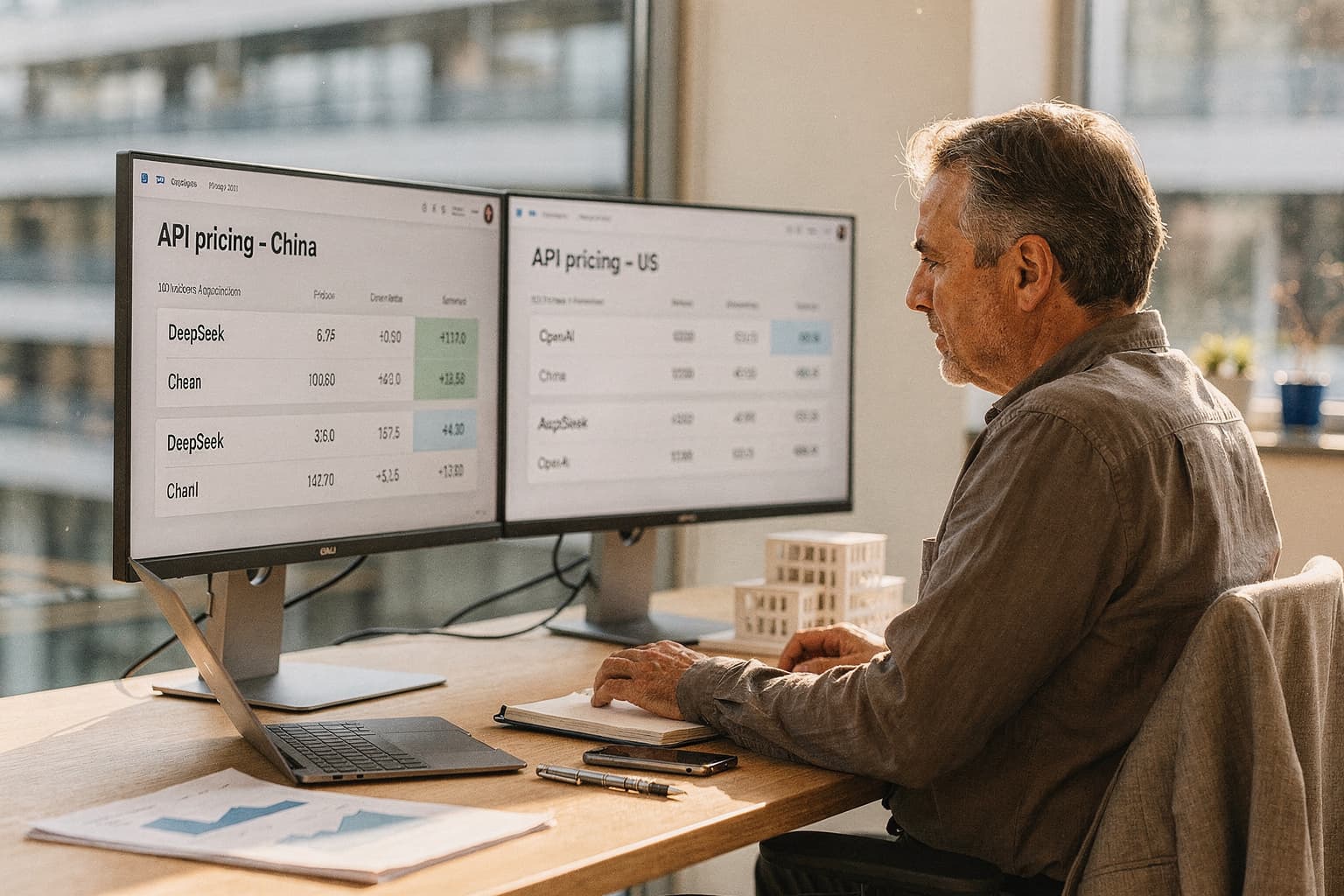
The drivers are quantifiable: DeepSeek V4 Flash costs $0.14 per million input tokens and $0.28 for output—while GPT-5.5 charges $5 and $30 per million respectively. That translates to a cost reduction of 60-90%. Coinbase now runs 1,200 AI agents on Chinese models and reports 50% lower operating costs. Lindy has migrated entirely from Claude to DeepSeek. Airbnb and Uber have publicly confirmed their usage.
Compliance Reality
The US House of Representatives has launched a joint investigation into national security risks. Simultaneously, China's Ministry of Commerce signaled in July 2026 potential restrictions on overseas access. The regulatory landscape is highly dynamic.
Why Swiss Decision-Makers Must Act Now
For Swiss decision-makers, the strategic landscape is shifting across three dimensions simultaneously: First, OpenAI dependence is increasingly becoming a balance-sheet risk—the company posted a loss of USD 20.9 billion in 2025. Second, Chinese models now achieve quality parity in many use cases. Third, self-hosting opens a third option between cloud providers.
The central question is no longer 'Which US model?' but rather 'Which multi-model strategy minimizes my total risk under revDSG, FINMA requirements, and strategic independence?' Our article 'ChatGPT, Claude or Gemini—Which AI System Fits Your Swiss Company?' already demonstrates that mono-vendor strategies are structurally risky.
The Vendor Lock-in Trilemma
You face three competing objectives: cost optimization, regulatory compliance, and strategic flexibility. Chinese models radically solve the first problem but exacerbate the second. Traditional US providers offer greater regulatory clarity but lock you into proprietary ecosystems.
- US models: GDPR-compliant but vendor lock-in and pricing power
- Chinese models: 60-90% cheaper but National Intelligence Law 2017
- Self-hosting: Full control but economically viable only above ~2M tokens/day
The Swiss Risk-Reward Framework: Your Decision Matrix
We have developed a structured framework for Swiss decision-makers that integrates the specific requirements of revDSG, FINMA, and data sovereignty. It is based on four evaluation dimensions.
Dimension 1: Data Classification and Routing
Not all workloads have the same risk profile. A pragmatic strategy segments by data class: Public content and marketing copy can run on cost-effective models. Customer data and proprietary information require self-hosting or EU-based infrastructure. Regulated data—financial information under FINMA, health data, personal data under revDSG—must remain in Swiss or EU data centers with appropriate contracts.
Procurement Practice Tip
Define three token pools with different compliance levels first. Routing logic can be automated—you pay premium prices only where legally or commercially required.
Dimension 2: Compliance Requirements in Practice
China's National Intelligence Law of 2017 obliges all Chinese organizations to cooperate with intelligence services. For Swiss companies, this means: API calls to China-hosted endpoints may violate revDSG Art. 16 (adequate level of protection). Self-hosting Chinese open-weight models in Swiss data centers circumvents this problem technically—but creates new questions around licensing and update mechanisms.
FINMA-regulated institutions face additional requirements: FINMA Circular 2023/1 on outsourcing mandates audit rights, availability assurance, and risk analyses. A cloud API call to Shenzhen structurally fails these criteria. Here, self-hosting or a certified EU/CH provider is mandatory.
~2M
Tokens per day as break-even point for economically viable self-hosting
Dimension 3: Total Cost of Ownership Over 36 Months
Pure API costs tell only part of the story. A complete TCO view—analogous to our framework in 'Measuring AI ROI: The CFO Guide for Swiss Companies'—must consider: API costs, prompt engineering and monitoring infrastructure, compliance audits and legal clarifications, migration and integration costs during vendor switches, and the risk of price increases post lock-in.
Our analysis shows: Below 500,000 tokens daily, managed APIs remain more cost-effective. Between 500,000 and 2 million tokens, the calculation becomes ambivalent—here, your compliance profile decides. Above 2 million tokens daily, self-hosting typically amortizes within 18 months, even when engaging external operators like KI-Outsourcing.ch.
Dimension 4: Strategic Independence and Diversification
OpenAI's loss figures and DeepSeek's momentum demonstrate: the provider market is volatile. A multi-model strategy with defined fallback options is not a technical nicety but business continuity planning. Concretely, this means: Abstraction via LiteLLM, LangChain, or custom orchestration layers. Prompt templates that function model-independently. Regular benchmark tests across all activated models. Contractual exit clauses and data portability commitments.
Anyone relying on a single LLM today is buying operational efficiency at the price of strategic vulnerability. In 24 months, that vendor could be insolvent, regulatorily blocked, or prohibitively expensive.
Self-Hosting as Third Option: When Does It Make Sense?
Self-hosting—operating open-weight models in your own or dedicated infrastructure—is technically demanding but offers maximum control. It suits you if you consistently process over 2 million tokens daily, FINMA or other regulation excludes cloud APIs, proprietary fine-tuning data cannot be shared externally, or strategic independence outweighs operational simplicity.
Apertus LLM: The European Sovereignty Option
ETH Zurich is developing Apertus, a sovereign, EU-compliant open-source model with confidential computing. For Swiss companies with highest compliance requirements, this could become the most attractive variant medium-term—currently still in development.
Operating costs for self-hosting include GPU infrastructure (either owned hardware or reserved instances with cloud providers), DevOps and MLOps capacity for deployment, monitoring, and updates, network and storage costs, and security and compliance audits. For most Swiss SMEs, outsourcing to specialized providers like KI-Outsourcing.ch makes more economic sense—you get self-hosting benefits without internal complexity.
The Three Archetypes: Which Path Fits You?
Based on our consulting practice, three typical profiles have crystallized.
Archetype A: The Pragmatic Multi-Vendor User
- Volume under 1 million tokens/day
- No highly regulated data (no FINMA, no health data)
- Strategy: Segmentation by data class—public workloads on DeepSeek/GLM, sensitive on Claude/GPT, most strictly regulated on EU provider or local hosting
- Tooling: Routing layer with automatic fallback logic
Archetype B: The Regulated Self-Hoster
- FINMA-regulated or highly sensitive data (banks, insurance, healthcare)
- Volume over 2 million tokens/day or strategic independence prioritized
- Strategy: Self-hosting of open-weight models (Llama, Qwen, Mistral) in Swiss data centers, optionally managed by specialized provider
- Compliance: Full data sovereignty, dedicated instances, Swiss legal jurisdiction
Archetype C: The Strategic Hybrid
- Medium to high volume, mixed compliance requirements
- Innovation and flexibility as core objective
- Strategy: Own self-hosting for base workloads + premium APIs for specialized tasks (e.g., multimodal, reasoning) + Chinese models for testing and non-critical volume jobs
- Organizationally: Internal competence center or external AI division like KI-Outsourcing.ch
Procurement Playbook: How to Negotiate Safely
Regardless of chosen archetype, you need contractual safeguards. Our recommendations for contract negotiations: Data Processing Agreements with explicit Swiss or EU clauses per GDPR Art. 28 or revDSG. Service Level Agreements with defined uptime guarantees (minimum 99.5%), response times, and escalation paths. Exit clauses with guaranteed data export in machine-readable formats and without exit fees. Audit rights, especially for FINMA-regulated institutions—you must be able to review subprocessors. Liability caps that match your actual risk—do not accept standard liability limitation to annual fees.
Red Flag with China APIs
If the provider does not name an EU representative, offers no GDPR-compliant DPA, or does not secure data transfers to China via Standard Contractual Clauses, this is an exclusion criterion for Swiss companies.
From Pilot Trap to Scalable Strategy
Most Swiss companies start with a proof of concept on a single model—often ChatGPT because it is best known. This is understandable but strategically risky. Our article 'From Pilot Trap to ROI: How Swiss SMEs Successfully Scale AI Agents' shows: scaling requires architecture, not just more prompts.
A future-proof architecture includes: Abstraction layer across all models (technically via LiteLLM, Portkey, or custom API gateway). Central prompt management with versioning and A/B testing capability. Token accounting and cost allocation per business unit. Monitoring and alerting for quality, latency, and compliance. Change management process for model switches—including regression tests.
Building this infrastructure typically requires 0.3-0.8 FTE over 6-9 months—unless you outsource it to a specialized provider. KI-Outsourcing.ch operates precisely this infrastructure as an external AI division for you: you get enterprise-grade orchestration, multi-model access, and Swiss compliance without internal build costs.
The Next 18 Months: What to Expect
The market will continue to dynamize. Three developments are emerging: More Chinese models will become available—Alibaba's Qwen and Baichuan AI are investing heavily. Regulatory clarification in the US and EU—possibly with explicit restrictions on Chinese APIs in critical sectors. Self-hosting becomes more economical—new inference optimizations and cheaper GPUs lower the break-even threshold from 2 million to under 1 million tokens daily.
For you as a decision-maker, this means: Do not wait for regulatory clarity that may never come. Build a flexible, diversified architecture now. Document your compliance decisions rigorously—regulators will audit retroactively in 12-18 months. And actively test Chinese models, but only in controlled, non-regulated contexts.
Conclusion: The Swiss Way Is Diversification with Compliance
The 46% threshold for Chinese models is not a temporary hype—it reflects a fundamental economic reality. At the same time, regulatory and geopolitical risks remain real and calculable. Your task as a Swiss decision-maker is not to choose sides but to build a strategy that functions under any development.
This means concretely: Segment your workloads by risk and volume. Build in abstraction—any vendor switch should be technically possible in days, not months. Document compliance decisions audit-proof. And regularly evaluate whether self-hosting or a specialized Swiss provider like KI-Outsourcing.ch strengthens your strategic independence.
The companies that will lead in 36 months are not those that found the cheapest model today—but those that built the most robust strategy today.
Frequently asked questions
- Are Chinese AI models like DeepSeek even legally usable under revDSG?
- Yes, but with restrictions. API calls to China-hosted endpoints may violate revDSG Art. 16 if personal data is transferred. Self-hosting Chinese open-weight models in Swiss data centers is technically compliant. Public, non-personal data can generally be processed. A case-by-case review by data protection and legal departments is mandatory.
- At what token volume does self-hosting become economically viable?
- The break-even point is currently around 2 million tokens per day. Below that, managed APIs are typically more cost-effective when factoring in DevOps, infrastructure, and compliance costs. Between 500,000 and 2 million tokens, the calculation becomes ambivalent—here compliance requirements decide. New inference optimizations continuously lower the threshold.
- How do I address vendor lock-in risk with OpenAI or Anthropic?
- Build an abstraction layer via LiteLLM, LangChain, or a custom API gateway. Keep prompts model-independent. Regularly test alternative models with the same workloads. Define contractual exit clauses with guaranteed data export. A multi-model strategy with at least two active providers operationally minimizes risk.
- May FINMA-regulated institutions use Chinese cloud APIs?
- In practice: no. FINMA Circular 2023/1 on outsourcing requires audit rights, availability assurance, and risk analyses. China-hosted APIs structurally fail these criteria. Self-hosting in Swiss data centers or certified EU providers are the compliant alternative. Individual case approvals by FINMA are theoretically possible but unlikely.
- What are the concrete security risks of deploying Chinese models?
- China's National Intelligence Law 2017 obliges organizations to cooperate with intelligence services. Prompt data could theoretically be intercepted or stored during API calls. Model poisoning and backdoors in open-weight models are theoretically possible but difficult to verify. Self-hosting reduces interception risk but does not eliminate risks in the model weights themselves. Segmentation by data class is the most practicable risk mitigation.
Sources
- Chinese AI models are gaining ground with U.S. companies as OpenAI, Anthropic costs surge
- 46% of Your AI Now Runs on Chinese Models
- Chinese AI Models Now Capture Up to 46% of US Enterprise Token Usage
- China's AI Is Spreading Fast. Here's How to Stop the Security Risks
- Chinese AI Compliance: Risk Framework for Business
- AI API Pricing Comparison 2026
Would you like to explore this topic for your company?
Check Availability