AI Insights for Decision-Makers
In-depth analysis, strategies and practical knowledge on artificial intelligence in the enterprise. Written for executives and decision-makers who see AI not as a gimmick but as a strategic lever.
Topic Areas
AI Outsourcing
Strategies, models and practice of outsourced AI operations for Swiss companies.
AI Agents
Autonomous AI agents in the enterprise: architecture, governance and ROI.
AI Strategy
AI transformation at C-level: roadmaps, compliance and value creation.
AI Automation
Process automation with AI: from idea to productive implementation.
Latest Articles

SAP Autonomous Enterprise and Joule Studio: What the New AI Agent Platform Means for Swiss SMEs
In May 2026, SAP unveiled its Autonomous Enterprise strategy at Sapphire in Orlando: a unified Business AI Platform, Joule Studio as a no-code/pro-code workbench for AI agents (GA Q3 2026), over 50 Joule Assistants orchestrating more than 200 specialized agents, and industry-specific AI. For Swiss SMEs running SAP S/4HANA or ECC, this means production-ready AI agents are now accessible without an in-house dev team—featuring zero-copy integration of your data landscape, no vendor lock-in, and a clear migration path that accelerates ERP projects by over 35 percent.
Read article
AI Prices Are Collapsing: What the 2026 Price War Means for Swiss SMEs
OpenAI cut GPT-5.6 Luna prices by 80% shortly after launch, responding to pricing pressure from DeepSeek, Kimi K3 and Llama. For Swiss SMEs, the entry barrier to powerful AI is collapsing, while model agility is becoming the new core competency.
Read article
Agentic AI Is Becoming Standard Before Governance Frameworks Are Ready
AI agents that plan, use tools and act on enterprise data have become default platform features at SAP, Microsoft, AWS and Oracle in 2026 — no longer opt-in pilots. With EU AI Act enforcement active since August 2, 2026, and existing access controls insufficient for agentic workflows, Swiss SMEs need a governance gate for every agent deployment now.
Read article
AI as Leverage, Not Labour: Why Swiss SMEs Must Shift From Hours to Leverage Now
AI replaces the revenue = hours × headcount model with genuine leverage: Swiss SMEs can scale productivity without hiring proportionally more staff. Custom apps, proactive agents and no-code automation turn every AI-literate employee into a multiplier — and the skills shortage into a strategic opportunity.
Read article
Data Governance for AI Agents: Why AI Projects Fail on Bad Data
AI agents rarely fail because of the model — they fail because of the data beneath it. Gartner projects that 60% of AI projects without AI-ready data will be abandoned through 2026, and MIT NANDA found 95% of GenAI initiatives deliver zero ROI. For Swiss SMEs, data governance is a precondition for success, not an IT afterthought.
Read article
Why AI Projects Fail: The Real Culprit Isn't the Technology
AI projects don't fail because the technology is immature — they fail because organisations never prepare their people for change. Research shows adoption rates of roughly 15 percent without structured change management, rising to 75 percent with it. Change management isn't overhead — it's the actual precondition for AI success.
Read articleAI Outsourcing vs. In-House Team: The Build-or-Buy Decision for Swiss SMEs
For most Swiss SMEs, AI outsourcing is faster and cheaper for bounded projects, while building an in-house team only pays off when AI becomes a permanent, core function with a clear IP advantage. The hybrid answer — an embedded team with governance built in — combines speed, cost control and knowledge retention.
Read article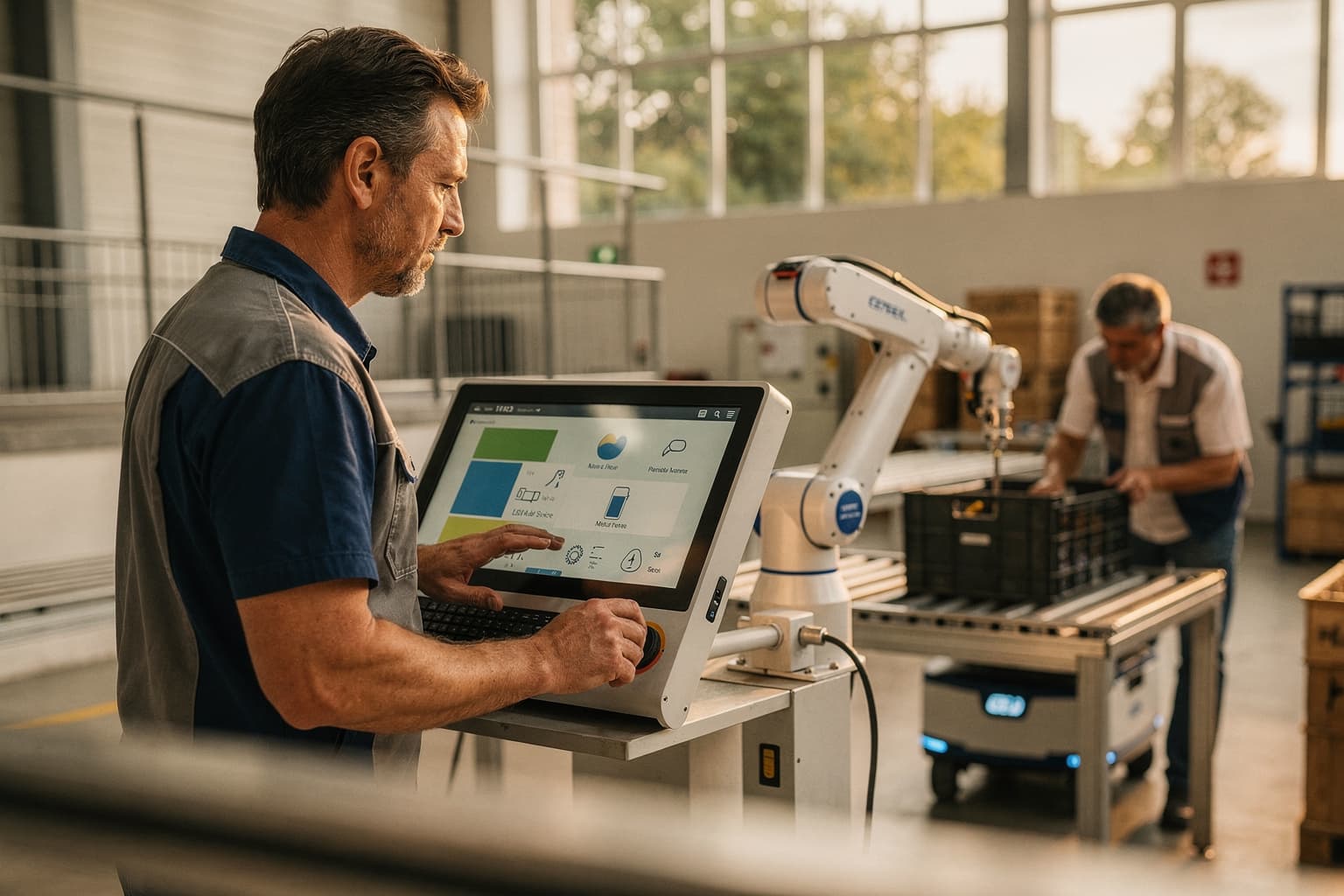
Robotics and AI Agents: Why They Strengthen Your Workforce, Not Replace It
Robotics and AI agents aren't job killers — they're the most pragmatic answer to the skills shortage facing Swiss SMEs. They take on repetitive, ergonomically harmful or data-heavy tasks, freeing people for decisions, client relationships and creative work. The key is clear delegation combined with genuine workforce buy-in.
Read article
AI Transparency Duty in 24 Hours: The Emergency Checklist for Swiss SMEs
From 2 August 2026, the transparency obligations under Article 50 of the EU AI Act become enforceable — including for Swiss SMEs without an EU presence, once their AI outputs are used in the EU. Companies lacking chatbot disclosure, labelled AI content, AI literacy, and an AI inventory risk fines up to EUR 15 million or 3% of global turnover.
Read article
AI Revenue Growth 2026: Why 2 Days, Not 180, Is No Hype
The AI industry now takes under 2 days to add the next $1 billion in cumulative revenue, down from roughly 180 days in 2023 - about 3 times faster than the internet or mobile eras. For Swiss companies, this means AI adoption delays no longer create linear disadvantages, but exponential ones.
Read articleHow Swiss SMEs Choose the Right AI Agent Vendor: A Practical Framework
An AI agent vendor only earns your trust if it satisfies the SAFE framework: secure and governed, accurate and explainable, fast to deploy, and extensible. Swiss SMEs should calculate TCO over three years, verify revDSG and EU AI Act compliance, and avoid vendor lock-in through open standards like MCP.
Read articleCalifornia and the EU, Same Day: Two AI Transparency Regimes Collide on August 2, 2026
On August 2, 2026, EU AI Act Article 50 and California's AI Transparency Act become enforceable on the same day. Both require disclosure of AI-generated content and chatbot interactions, but with different definitions, thresholds and penalty structures. Swiss companies active in both markets need two separate compliance proofs, not one shared document.
Read article
What Swiss SMEs Can Learn From China's Involution Culture
China's 'involution' - ruinous competition marked by weekly product iterations - has driven 400 of 500 EV makers into bankruptcy. Swiss SMEs should adopt the iteration speed, not the price war: faster learning cycles, leaner processes, shorter time-to-market - without sacrificing quality or margins. AI outsourcing makes that pace possible without building in-house overhead.
Read article
GPT-5.6 Luna: 80% Price Cut Puts Budget AI Ahead of Gemini Flash
OpenAI cut GPT-5.6 Luna's price by 80% on 30 July 2026, to $0.20 per million input tokens. Luna now undercuts Gemini Flash-Lite and scores 51.2 in the Artificial Analysis Intelligence Index, ahead of Gemini 3.6 Flash — a sign that powerful AI is now dramatically more affordable for Swiss SMEs.
Read articleChina's AI Agent Rules 2026: What Swiss SMEs Must Know
In July 2026, China introduced the world's first binding regulations dedicated specifically to AI agents: a three-tier authorization model, mandatory filing and recall duties for high-risk sectors, and strict rules for emotional AI. Swiss companies operating in China face immediate compliance obligations - and a preview of rules likely to reach the EU and Switzerland in the near term.
Read article
EDIHs and Swiss AI Centre: How Swiss SMEs Access Free AI Programmes
Swiss SMEs can now access EDIHs, the Swiss AI Centre, the Canton Zurich AI Innovation Programme and Innosuisse funding: free consulting on use-case identification, test infrastructure, access to AI engineers, regulatory guidance on the EU AI Act and revDSG, and up to 50 percent project funding - if you know where and how to apply.
Read article
Which AI Model Fits Which Budget? Intelligence per Dollar in 2026
AI procurement is shifting in 2026 from a performance race to a cost-efficiency calculation. Prices between models span a factor of 1,250 – from $0.06 to $75 per million tokens. What matters isn't the most powerful model, but the one with the best price-performance ratio for your specific use case: customer support, document analysis, or code generation.
Read article
How AI Agents Really Work: The Tool-Calling Mechanism Explained
An AI agent differs from a chatbot through an iterative loop: it reasons about the next step, acts by calling a tool, and observes the result — repeating until the task is complete. This function-calling mechanism determines the cost, control and risk of any agentic AI investment.
Read article
Why Rich Countries Fear AI While Poor Countries Race Ahead
Rich countries like Switzerland and the US hesitate on AI because they have more to lose - jobs, institutions, stability. Poor countries see leapfrogging opportunities instead. For Swiss SMEs the calculus is identical: waiting doesn't just cost opportunity, it creates a rapidly widening gap against bolder competitors.
Read article
July 2026 Model Wave: Why Model Agility Beats Model Choice
In July 2026, Anthropic, OpenAI and xAI each shipped flagship models within three weeks - a release cadence that has roughly quadrupled since 2023. For Swiss SMEs, the strategic question is no longer which model is best, but how to build model-agnostic architecture that captures every new generation automatically.
Read article
DACH AI Adoption Benchmark 2026: Where Swiss SMEs Really Stand
The DACH AI Adoption Benchmark 2026 finds Swiss SMEs sitting in the middle of the German-Austrian-Swiss comparison – neither leaders nor laggards. The shared weak point across all three countries is the leap from pilot projects to reliable production use, held back by poor data quality and thin AI governance.
Read article
Oracle Cuts 30,000 Jobs for AI Infrastructure: What It Means for Swiss SMEs
Oracle is cutting up to 30,000 jobs to redirect $8–10 billion annually into the Stargate data centre buildout, while TCS and Microsoft deploy thousands of AI engineers directly to clients. For Swiss SMEs, this means intensifying competition for AI talent and outsourcing shifting from an option to a strategic necessity.
Read article
From AI Novice to AI Champion: The OECD Maturity Ladder for SMEs
The OECD G7 AI taxonomy (April 2026) defines four SME maturity stages: 76% of AI-using SMEs remain "AI Novices" relying on simple, off-the-shelf tools for isolated tasks, while only 3.6% reach "AI Champion" status with tailored, organisation-wide deployment. The framework gives you a concrete next step, not just another statistic – and shows how Swiss support programmes (EDIHs, Innosuisse CHF 100k–1M, Regulatory Sandboxes, Apertus LLM) enable the climb to Champion, within a projected CHF 15 billion annual AI innovation by 2034.
Read article
AI as a Black Box: What It Means for High-Stakes Deployments
AI models are black boxes because no one can trace how a language model retrieves its compressed knowledge to produce a specific output. In high-stakes settings like diagnosis or credit decisions, that's a real liability and governance risk—not a technical footnote.
Read article
EU Frontier AI: What the 400-Billion-Parameter Model Means for Swiss SMEs
On 19 June 2026, the EU Commission named the Domyn-led EUROPA consortium winner of the Frontier AI Grand Challenge: an open-source model with 400+ billion parameters in all 24 EU languages, built using 2.5% of EuroHPC's compute capacity. For Swiss SMEs, this opens a third option beyond US and Chinese vendors – though real-world availability remains months away.
Read article
From AI Assistants to AI Agents: Why 2026 Is the Year of Autonomous Agents
AI agents plan and execute multi-step tasks autonomously, while assistants like ChatGPT only react to prompts. In 2026, agents move beyond pilots: Gartner and IDC expect agentic automation to enhance over 40% of enterprise applications by 2027 — a shift that will likely affect mid-market firms as well.
Read article
Open-Weight AI: Why Big Tech Pushes It — and What SMEs Gain
Microsoft and NVIDIA back open-weight models not out of altruism, but because open weights drive demand for their chips and cloud platforms. For Swiss SMEs, that same self-interest delivers cheaper, more transparent, more adaptable AI—without vendor lock-in.
Read article
Agent Standards War: What the MCP Battle Means for Swiss SMEs
In mid-July 2026, Google, Microsoft, Salesforce, Snowflake and ServiceNow formed an alliance against Anthropic's Model Context Protocol, which has become the de facto agent standard with roughly 97 million monthly SDK downloads. For Swiss SMEs, this means the choice of agent ecosystem is a strategic commitment affecting cost, flexibility and data sovereignty — not a technical footnote.
Read article
GPT-5.6 Sol, Terra, Luna: What OpenAI's Model Family Means for Swiss Companies
In July 2026, OpenAI released not one flagship model but a family: Sol for heavy reasoning, Terra for balance, Luna for speed. For Swiss decision-makers, this means model choice per task now matters as much as software architecture — running everything on one model means overpaying or underperforming.
Read article
Swiss AI Action Plan 2026: What the National Roadmap Means for SMEs
The digitalswitzerland AI Action Plan (June 2026) defines seven core pillars for Switzerland's AI transformation: industry-specific playbooks, modular micro-credentials for training, European Digital Innovation Hubs as testing environments, sovereign foundation models like Apertus, federated data infrastructure, international cooperation, and a national governance framework. For SMEs, the playbooks and EDIHs offer immediate value by providing practical guidance and access to low-risk pilot environments—a critical bridge given that only 8% of Swiss SMEs currently deploy AI.
Read article
What Swiss SMEs Can Learn from China's AI Industrialisation
The World Artificial Intelligence Conference 2026 in Shanghai reveals a fundamental shift: China does not focus on the largest language models but on comprehensive industrialisation. Of 1,024 exhibitors, 242 showcased robotics and hardware, only 130 generative AI—and of those, 83 presented AI agents rather than foundation models. The lesson for Swiss SMEs: success with AI is determined not by model size but by concrete applications in manufacturing, supply chain and knowledge work.
Read article
AI Is No Longer a Tool – It's Your Business Partner
AI systems are no longer passive tools that execute commands. They are evolving into active business partners that think alongside you, propose solutions, and make autonomous decisions. According to Deloitte, 79% of enterprises already deploy AI systems that go beyond simple automation. McKinsey shows that companies treating AI as a strategic partner achieve 2.5 times higher productivity gains. This mindset shift from 'AI as tool' to 'AI as partner' requires new forms of collaboration, clear accountability, and a fundamentally different leadership approach. For SMEs, this means: those who see AI merely as an efficiency tool are missing strategic potential.
Read article
AI as Evolution of Learning Tools: From Pencil to AI Assistants
AI is not a threat but the logical continuation of a centuries-old tool evolution: from the pencil via the keyboard to the AI assistant. Every generation had its learning tool, and each time the focus shifted—from pure reproduction toward more complex thinking. Today that means: rote memorisation loses value, while critical thinking, asking the right questions, and validating AI output become core competencies. For Swiss SMEs this translates concretely into rethinking training: shift from factual knowledge toward judgement, contextual understanding, and confident use of AI tools.
Read article
US Executive Orders on AI Safety: What the New Frontier Model Regulation Means for Swiss Enterprises
On June 2, 2026, an executive order came into force requiring frontier models to undergo up to 30 days of pre-release review by the US government before being released to trusted partners. For Swiss companies, this means availability becomes a geopolitical question. The shutdown of Fable 5 and Mythos 5 on June 13, 2026, for national security reasons proves the kill switch is real. Multi-model strategies and sovereign alternatives are no longer nice-to-have—they are risk management.
Read article
The AI Workforce Manager: The New Key Role for Human-Machine Teams
When AI agents evolve from tools to teammates, organisations need a new role: The AI Workforce Manager orchestrates not technology, but daily collaboration — from task allocation and escalation paths to conflict resolution. The World Economic Forum identifies this position in 2026 as a critical function for hybrid teams. Swiss SMEs need it from three active agents onwards or when human-machine handoffs occur daily.
Read article
Anthropic Awards $50,000 Credits for Rare Disease AI Research – How AI is Revolutionising Medicine for Rare Diseases
Anthropic is providing up to $50,000 in Claude credits for rare disease research through its AI for Science programme – applications open until 2 August 2026. The initiative targets a paradigm shift: 400 million people suffer from over 7,000 rare diseases, most without therapies because they are economically unattractive. AI can now identify patterns in fragmented data, synthesise literature, and connect disease mechanisms – and API access makes state-of-the-art technology available to small research groups, patient organisations, and non-profits that cannot afford their own infrastructure.
Read article
AI Center of Excellence: How Swiss SMEs Coordinate Their AI Transformation
The biggest hurdle to scaling AI is not technological but organizational. McKinsey shows that 83% of companies recognize the need for a new operating model, yet 65% lack a coordination structure. An AI Center of Excellence closes this gap—and in Swiss SMEs can start with a single, deeply embedded person before growing into a cross-functional team.
Read article
The AI ROI Paradox 2026: Why 56% of CEOs See No Measurable Returns — And How to Fix It
PwC's 2026 Global CEO Survey reveals a paradox: 56% of executives report zero measurable revenue growth or cost savings from AI investments, even as a growing share of companies already deploy agentic AI. The issue is not the technology—it is missing measurability, unclear governance, and insufficient workforce training. Companies that combine ROI metrics, clear accountability, and systematic training achieve up to 3× higher success rates (BCG 2026).
Read article
What Swiss SMEs Can Learn About AI Resilience From China's Response to US Sanctions
When NVIDIA CEO Jensen Huang declared US export controls a failure in 2025, he spoke an uncomfortable truth: sanctions accelerated China's AI self-sufficiency, and NVIDIA's market share fell from 95 to 50 per cent. Huawei's Chairman thanked the US government in 2026 — forced independence enabled SMIC's 7nm breakthrough. For Swiss SMEs, the strategic lesson is clear: vendor diversification and technology sovereignty are no longer optional but business-critical. Relying on a single provider today means accepting geopolitical risks you cannot control.
Read article
The 0.15% Gap: Why 99.85% of AI Users Forgo Agents—and What That Means for Your Business
While 22% of knowledge workers in developed economies use AI tools, only 0.15% deploy autonomous AI agents—despite their demonstrably higher productivity gains and strategic value. The gap stems from complexity, missing infrastructure, and risk awareness. Companies that overcome these barriers unlock long-term competitive advantages.
Read article
AI Price Deflation 2026: Why Falling Model Costs Lower the Entry Barrier for Swiss SMEs Now
AI model costs have fallen by over 90% since 2022—faster than PC prices over 15 years. Simultaneously, hyperscalers are investing $757 billion in 2026, massively expanding infrastructure. For Swiss SMEs, this deflation means AI outsourcing becomes truly affordable for the first time, while the strategic question shifts from 'Can we afford AI?' to 'Which models, which vendors, and what timing maximise our ROI?' The make-vs-buy decision, vendor diversification, and quality-adjusted cost comparisons move to the forefront—and those who set the right course now gain a measurable competitive edge.
Read article
EU Cloud and AI Development Act (CADA): What Swiss SMEs Need to Know About Infrastructure Sovereignty
The EU Cloud and AI Development Act (CADA) introduces four sovereignty levels that will de facto become procurement guidelines for Swiss companies with EU business. Level 1 requires EU infrastructure, Level 2 additionally demands independence from third-country laws such as the US CLOUD Act, Level 3 requires EU ownership and control. Around 80 per cent of professional cloud spending in the EU currently goes to US providers – CADA addresses this strategic vulnerability through harmonised compliance assessment from 2028/2029, yet many procurement bodies already demand the criteria today.
Read article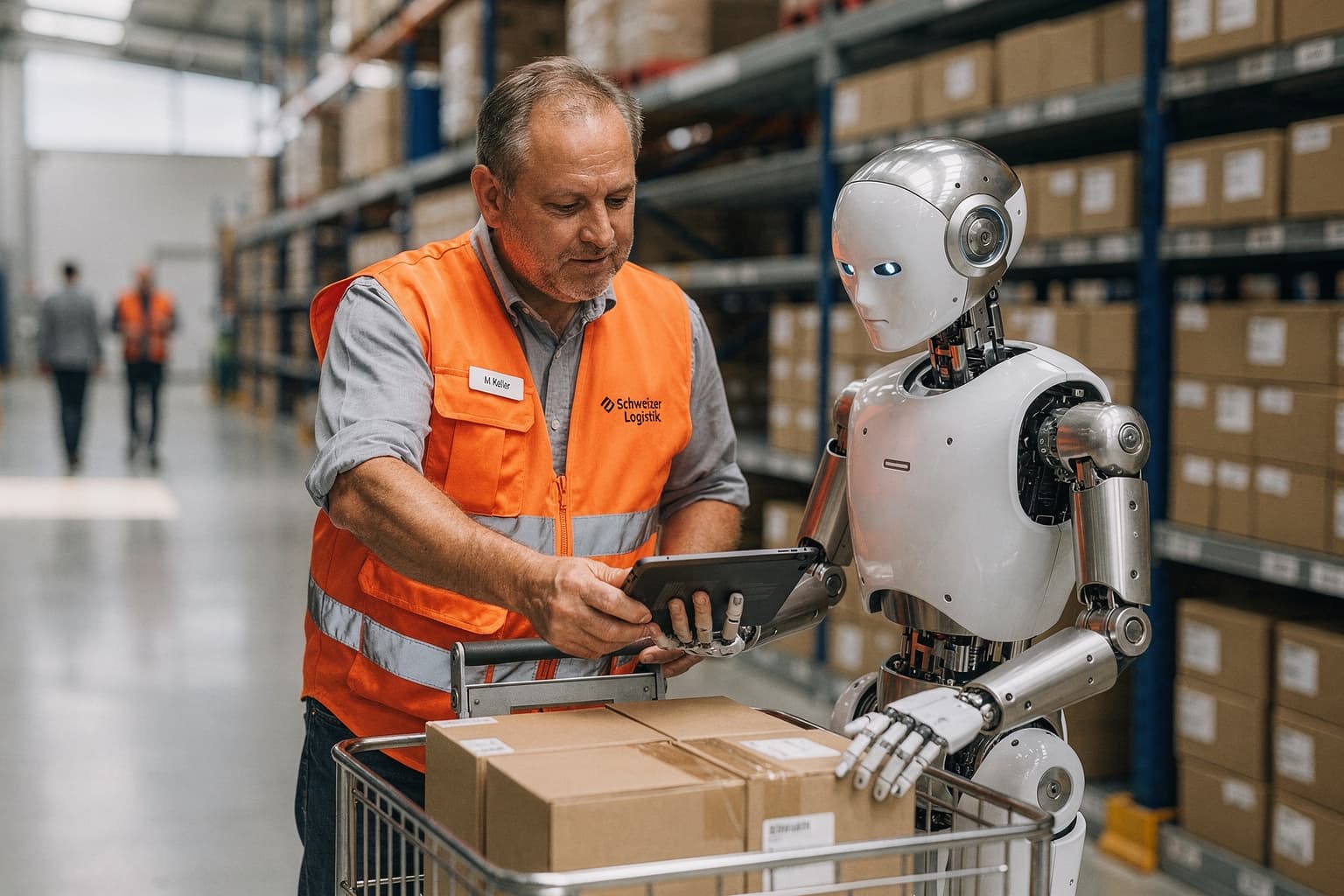
Humanoid Robotics Reaches Mass Production: What It Means for Swiss Companies
Humanoid robots are leaving research labs in 2026 and entering mass production. China will dominate with an 80-90% global market share as prices drop to $16,000-$45,000. Roland Berger reveals that 73% of European industrial companies have concrete adoption plans, primarily for logistics, manufacturing, and service. The RaaS model enables entry from $500 monthly. The bottleneck isn't mechanics but energy density, runtime, and scalable learning transfer—precisely where DACH companies must make strategic decisions.
Read article
Infinity.swiss Raises CHF 3 Million for Autonomous Accounting – How AI Startups Are Transforming Switzerland's Fiduciary Sector
Zurich-based startup Infinity.swiss closed a CHF 3 million seed round on July 2, 2026—led by Founderful alongside Swiss Angels, Wingman Ventures, and prominent angels from Scandit, Planted, and Yokoy. The mission: eliminate manual bookkeeping for Swiss SMEs by 2030 through autonomous AI agents. This funding milestone demonstrates that specialized AI solutions for core administrative processes are not only technically mature but also align with the broader industry trend of deploying highly focused agents over generic platforms—especially where Swiss compliance and data minimization are paramount.
Read article
EU AI Act Transparency Obligations: Why Many Swiss Companies Can (Still) Ignore Them
On 2 August 2026, the EU AI Act transparency obligations become binding – but far from every Swiss company must comply. The extraterritorial effect only applies if your AI output is actually used in the EU. Pure Switzerland-focused providers without EU customers can ignore the rules. The Code of Practice (June 2026) provides clarity: chatbot labelling, machine-readable metadata, deepfake labels – but only for EU-relevant systems. Many C-level executives reflexively copy EU compliance; a targeted, pragmatic approach would be smarter and cheaper.
Read articleSwitzerland's AI Paradox: World Leader in Talent, Only 8% SME Adoption
Switzerland tops the Stanford AI Index 2026 with 110.5 AI specialists per 100,000 people—yet only 8% of small enterprises deploy AI systems, compared to 34% of large corporations. KOF ETH data show 62% limit use to basic tasks, and just 34% have governance rules. Switzerland's AI paradox is not a technology gap but an organizational and leadership challenge.
Read article
Mira Murati Releases Inkling: Thinking Machines Lab's First Open-Weight Model
Mira Murati, former CTO of OpenAI, has released Inkling through her startup Thinking Machines Lab. The multimodal mixture-of-experts system features 975 billion parameters (41 billion active), operates under an Apache 2.0 license, and enables Swiss enterprises to fully self-host, customize, and optimize a high-performance AI model for specialized domains—without vendor dependency and with controllable thinking effort balancing cost efficiency and maximum performance.
Read article
The 76% Paradox: Why Swiss SMEs Remain AI Adoption Novices
Swiss SMEs experiment with AI – yet hardly anyone truly implements it. 34% use AI tools, but 76% remain at novice level, restricting themselves to ChatGPT for emails. Only 3.6% reach champion status with integrated, productive AI. The gap between 'tried' and 'implemented' is widening – despite 52% expecting ROI <1 year and CHF 15bn projected annual AI innovation gain by 2034. Champions follow three patterns: they buy instead of build, redesign workflows, and rely on user-driven adoption. The Swiss AI Roadmap 2026 now offers structural answers – EDIHs, Innosuisse funding, regulatory sandboxes.
Read article
Swiss Companies Invest More Heavily in AI Than the Rest of Europe – But the Workforce Lags Behind
Swiss companies invest significantly more in AI than their European neighbours and expect faster ROI – yet only 24 per cent train their employees systematically, compared to 37 per cent across the EU. Workforce adoption stands at just 31 per cent. This disconnect between investment and enablement, combined with emerging governance gaps and the SME reality of 34 per cent AI usage, reveals a core insight: technology budgets alone are insufficient. Without structured workforce readiness, investment dissipates and the expected ROI fails to materialise.
Read article
Meta Builds Cloud Business: What It Means for Swiss Enterprises
Meta is developing 'Meta Compute,' a cloud division to sell excess AI computing capacity—hosted model access like AWS Bedrock plus bare-metal GPU rental. The move threatens neoclouds CoreWeave and Nebius, which supply Meta itself, and fundamentally shifts make-vs-buy calculations for Swiss enterprises. Vendor diversification moves from nice-to-have to risk management, and the AWS-Azure-Google oligopoly faces its first serious competition.
Read article
Swiss Companies Lead in AI Productivity – But the Edge Is Fragile
Swiss companies are ahead in AI productivity: 65% of local AI users report productivity gains, compared to 58% worldwide, according to the Microsoft Work Trend Index 2026. But this lead is not guaranteed. It rests on three often-overlooked factors: targeted development of Frontier Professionals (the 10% power users who are 2.7 times more productive), building organisational AI maturity beyond tool licensing, and closing the massive skills gap – 71% of employees want training, yet only 41% feel supported.
Read article
Microsoft Work Trend Index 2026: Swiss AI Users Achieve the Impossible – But Leadership Alignment Lags
The Microsoft Work Trend Index 2026 reveals a paradox: 65% of Swiss AI users now produce work that was simply impossible twelve months ago – a seven-percentage-point lead over the global average. Among Frontier Professionals, the figure climbs to 83%. Yet while individual productivity surges, a dangerous gap persists: only 24% of respondents say their leadership is clearly aligned on AI. The core insight: organizational factors – culture, manager support, talent practices – deliver twice the impact of individual effort alone.
Read article
OpenAI GPT-Live: Real-Time AI Conversations and What They Mean for Swiss Enterprises
In July 2026, OpenAI launched GPT-Live—a new product category featuring a bidirectional real-time voice model that listens and responds simultaneously, translates live across 20+ languages, and delegates tasks to third-party systems. For Swiss enterprises, this marks a paradigm shift from reactive chatbots to proactive AI agents that act contextually as Ambient AI. Executive boards and C-suite leaders must now address governance questions, ensure data-protection compliance, and pilot strategically before this technology becomes the competitive standard.
Read article
Salesforce Invests $1 Billion in Switzerland – What It Means for Your AI Strategy
On July 7, 2026, Salesforce announced a $1 billion investment over five years in Switzerland—immediately before the AI for Good Global Summit in Geneva. Swiss companies like Oviva, FREITAG, and the WEF are already running Agentforce in production. For you as a decision-maker, this means stronger local presence and better skills infrastructure, but also heightened vendor lock-in risks and new questions around data sovereignty, AI governance under Swiss data protection law, and the make-vs-buy equation in the agentic AI transformation.
Read article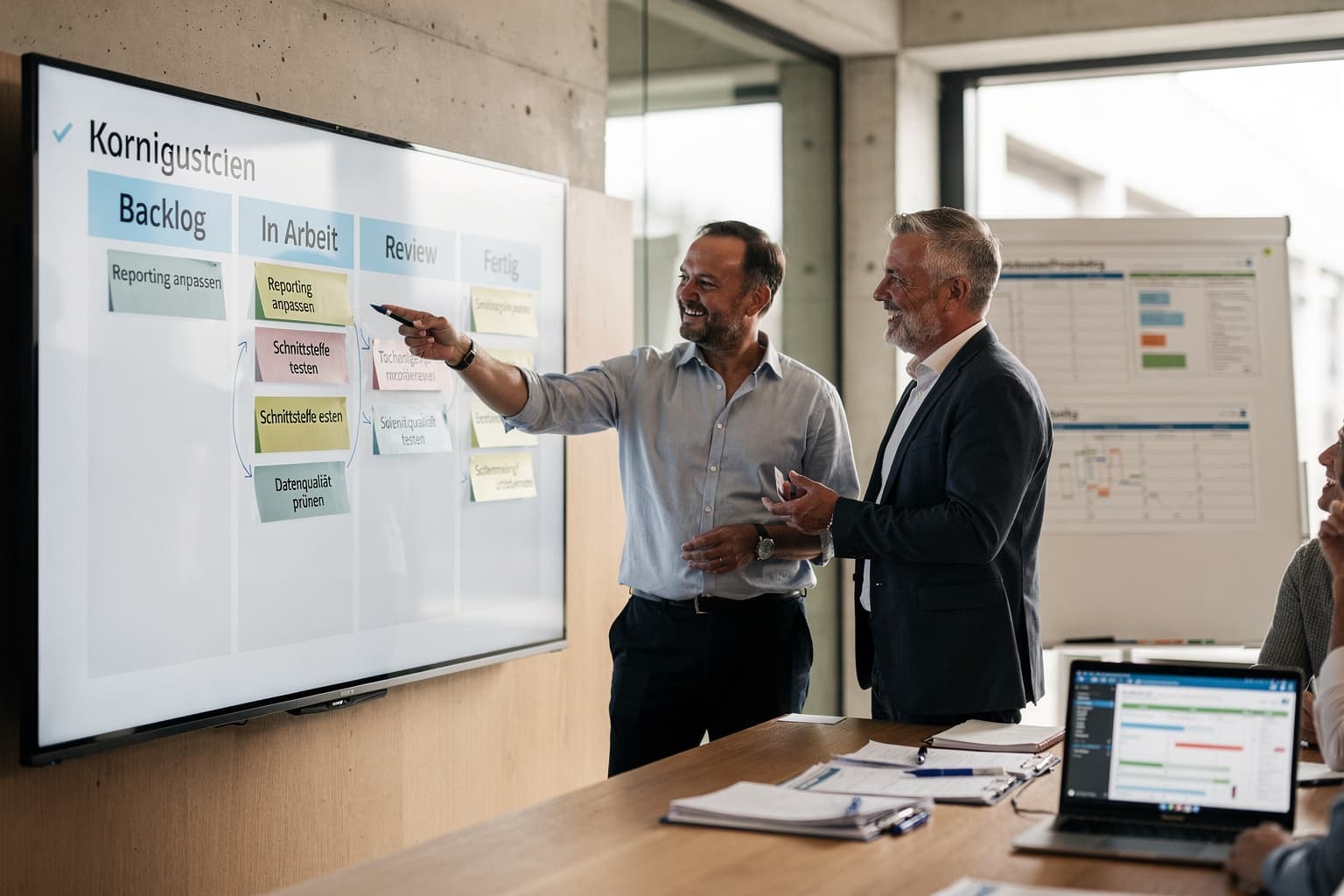
Scrum Is Dead, Kanban Is Back: Why AI-Powered Development Enables Daily User Acceptance Testing
The fundamental constraint in software development has shifted: implementation is no longer expensive—decisions are. AI-accelerated workflows make daily User Acceptance Testing practical and pose an existential question to Scrum. While top performers achieve 16-30% productivity gains, studies show 78% use AI but 80% see no business impact. The reason: Scrum still optimizes the old constraint—fixed sprint cycles no longer fit feature development that's faster than creating a Jira ticket.
Read article
China AI Companion Law: 345 Million Users Lose Their AI Agents
On July 15, 2026, China's regulation for emotional AI companions takes effect. ByteDance (Doubao) and Alibaba (Qwen) are shutting down their personalized agent features because mandated anti-addiction systems and two-hour interruptions are architecturally incompatible with persistent, emotionally binding AI agents. 345 million users lose access. The measure demonstrates that emotional AI must be regulated differently from productivity-oriented assistants—an insight relevant for Swiss enterprises deploying autonomous AI agents.
Read article
Chinese AI Models Capture 46% of Enterprise Market: Your Swiss Decision-Maker's Guide
Chinese AI models such as DeepSeek, Qwen, and GLM have captured 30-46% market share among US enterprises within 18 months—driven by 60-90% lower costs than OpenAI and Anthropic. For Swiss decision-makers, this fundamentally shifts the make-versus-buy equation. This guide shows you how to seize the opportunity while ensuring revDSG compliance, FINMA requirements, and data sovereignty—with a clear procurement framework, self-hosting options, and strategic vendor diversification.
Read article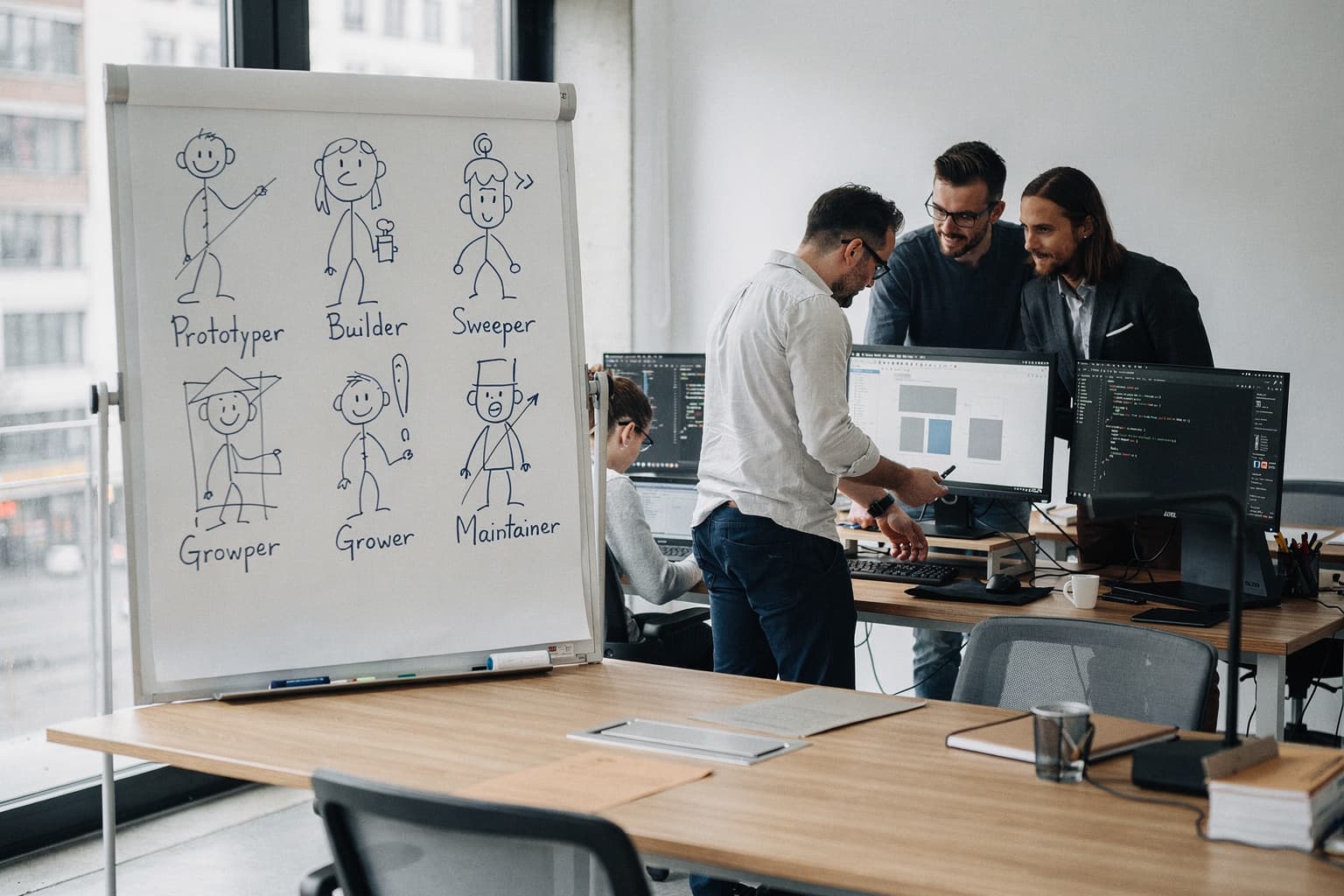
From Job Titles to Archetypes: How AI Dissolves Classic Software Roles
Engineering, Product, Design, and Data Science are merging into a new kind of role in software development. Boris Cherny, Creator of Claude Code at Anthropic, observes five archetypes replacing classic titles: Prototyper, Builder, Sweeper, Grower, Maintainer. The role follows the product phase, not the CV. For Swiss companies, this means: recruiting logic, vendor selection, and internal structures must be recalibrated—without jeopardizing governance and compliance.
Read article
Google Gemini 3.5 Pro: What did NOT happen on 17 July – and why vendor diversification is mission-critical
Google Gemini 3.5 Pro did NOT appear on the promised 17 July 2026. The model remains in a full rebuild after Google scrapped the entire 2.5 Pro architecture. While Google rebuilds, GPT-5.6 (launched 9 July) and Claude Fable 5 (restored 1 July) are already available. Mashable reported on 27 July: "The AI model is still MIA." Community speculation: August 2026. For Swiss enterprises, the lesson is clear: waiting for the perfect model erodes operational continuity. Vendor diversification is no longer optional—it's risk management.
Read article
Wait or Act? Why AI Hesitation Costs More Than Structured Investment in 2026
The question is legitimate: Should Swiss companies wait on AI until technology and regulation mature further? The answer in 2026 is no. The risks – EU AI Act, vendor lock-in, hallucinations – are real, but structured action with clear governance frameworks is now lower-risk and more cost-effective than hesitation. While you wait, competitors build data advantages that cannot be recovered. 93% of companies understand AI risks better today than two years ago, and 82% already measure positive revenue effects. The transition from pilot projects to production is the decisive moment in 2026 – waiting now means paying monthly in opportunity costs that cannot be offset retrospectively.
Read article
Tencent Hy3: What the New Free Agentic Model Means for Swiss Businesses
On July 6, 2026, Tencent released Hy3 – a 295 billion parameter Mixture-of-Experts model under Apache 2.0 license with two weeks of free API access via OpenRouter. Scoring 78% on SWE-Bench Verified, 90.4% on GPQA Diamond, and delivering stable tool-calling, Hy3 positions itself as a cost-efficient alternative for agentic workflows. For Swiss decision-makers, this means: structured piloting without budget risk until July 21, vendor diversification beyond US hyperscalers, and a make-versus-buy calculation that factors in Swiss DPA and FINMA compliance. The Apache 2.0 license permits self-hosted inference or Swiss/EU cloud deployment – both sovereign options versus Chinese Tencent Cloud jurisdiction.
Read article
SpaceXAI: Why Elon Musk Rebranded xAI – and What the AI Consolidation Means for Swiss Enterprises
On 6 July 2026, xAI ceased to exist as a separate brand and was fully integrated into SpaceXAI – the $1.25 trillion acquisition created a vertically integrated AI conglomerate combining language models (Grok), space infrastructure, social networks and the vision of orbital data centres under one roof. For Swiss C-level decision-makers, this consolidation is a case study in vendor lock-in risk, make-vs-buy calculations and the critical distinction between visionary investor narrative and production-ready services with binding SLAs.
Read article
AI Pricing as Hidden Wealth Tax: How Token Billing Makes Swiss Enterprises Dependent
On July 1, 2026, Palantir CEO Alex Karp called frontier AI pricing a wealth tax on enterprises. Token-based billing escalates uncontrollably: Uber exhausted its entire 2026 AI budget within four months. Swiss decision-makers need cost controls, sovereign alternatives and an honest make-vs-buy calculus before the pricing power of frontier labs becomes a strategic risk.
Read article
Forward-Deployed Engineering: When AI Outsourcing Becomes the New Normal
On 2 July 2026, Microsoft announced Frontier Company: $2.5 billion and 6,000 engineers for Forward-Deployed Engineering. Two days earlier, Amazon invested $1 billion in the same model. What Palantir developed 20 years ago in intelligence agencies is becoming the industry standard: specialised tech teams work permanently embedded with clients, designing, implementing and operating AI systems operationally. For Swiss enterprises, the make-vs-buy decision shifts fundamentally – from traditional consulting to operational deployment.
Read article
UN Global Dialogue on AI Governance in Geneva 2026: Strategic Opportunities for Swiss Companies
On 6 and 7 July 2026, Geneva hosts the first-ever UN Global Dialogue on AI Governance—a historic gathering of 194 governments, private sector, and civil society, co-convened by Switzerland. For Swiss companies, this means early access to emerging global governance standards, strategic positioning as a trusted AI hub, and concrete opportunities through Geneva's mediator role between the EU, US, and global actors. While the EU pursues regulatory harmonisation via the AI Act, Switzerland opts for sector-specific solutions and soft law—and can now position itself as a bridge-builder.
Read article
AI Agent Security: Why Autonomous AI Systems Become the Largest Attack Vector in 2026
AI agents are becoming the greatest cybersecurity risk in 2026: 48% of security professionals classify autonomous AI systems as the primary attack vector. Each deployed agent expands the attack surface by over 450% compared to human users. Swiss enterprises must immediately implement zero-trust architectures, establish non-human identity management, and secure MCP servers to ensure FINMA compliance and operational security.
Read article
Agentic Arbitrage: When AI Agents Replace Classic Enterprise Software
On July 1, 2026, Gartner published a forecast that should concern every enterprise software buyer: by 2030, up to $234 billion in enterprise application spending—roughly 20 percent of the SaaS market—is exposed to 'agentic arbitrage.' AI agents complete tasks across multiple systems, rendering traditional UX-driven applications increasingly obsolete. For Swiss organizations with substantial investments in SAP, Salesforce, and Microsoft, this means software budget decisions must be recalibrated, governance gaps closed, and licensing structures rethought—before the arbitrage hits.
Read article
Measuring AI ROI: The CFO's Guide for Swiss Enterprises
AI investment measurement fundamentally shifted in 2026: Direct P&L impact nearly doubled as the primary ROI metric, while productivity-based measurement collapsed by 24%. Yet only 29% of executives can reliably measure AI ROI. For Swiss CFOs, this means the traditional 'hours saved' narrative no longer suffices. This guide provides a structured framework with TCO model, baseline documentation, kill criteria and the make-vs-buy calculation for AI outsourcing — all in the language of the finance executive.
Read article
AI and Workforce Strategy: Why AI-Driven Headcount Cuts Deliver No ROI
A landmark Gartner study of 350 executives reveals that 80 percent of organisations have made AI-related workforce reductions, yet these cuts show no correlation with higher ROI. Simultaneously, fresh Swiss labour market data shows a bifurcation: entry-level positions down 32 percent, while AI-exposed firms grow headcount 52 percent faster. The winning strategy is people amplification—using AI to dramatically boost existing talent productivity, not replace it. This is the defining C-level workforce decision of 2026.
Read article
AI Agents in Production: Which Platform Fits Your Business?
AI agents can today be deployed in production on several world-class platforms – from Amazon Bedrock AgentCore and Azure AI Foundry to Google Vertex AI and the Vercel AI SDK. The decisive question is not which platform is best, but which one fits your specific requirements, existing infrastructure and organisational capabilities.
Read article
ChatGPT, Claude or Gemini – Which AI System Fits Your Swiss Enterprise?
The definitive decision guide for Swiss CEOs and C-suite leaders: ChatGPT (incl. the new GPT-5.6 series Sol/Terra/Luna), Claude, Gemini, Perplexity, Grok or a European model like Mistral – which platform suits which use case? Including OpenAI financial risk assessment, revDSG data protection and a clear decision matrix. June 2026 edition.
Read article
From Pilot Trap to ROI: How Swiss SMEs Successfully Scale AI Agents
95% of all AI agent pilots fail to scale—not due to technology, but structural leadership failures (MIT NANDA 2026). Swiss SMEs face a critical juncture: while 49% have launched pilot projects, only 5% achieve measurable business impact. Three decisions make the difference: use-case economics before technology exploration (vendor solutions achieve 67% success rate vs. 33% for internal builds), orchestration architecture from the outset, and measurable governance. Deloitte 2026 shows: employee AI access rose 50% in 2025, yet 60% of companies generate no material value. Companies with defined business cases achieve CHF 8,000–25,000 monthly savings from the third operational month.
Read article
EU AI Act August 2026: The Deployer Compliance Checklist for Swiss Companies
From 2 August 2026, EU AI Act high-risk obligations apply to all deployers — including Swiss companies whose AI outputs are used in the EU. This article provides the complete obligation catalogue, an operational checklist, and concrete action steps for C-suite executives.
Read article
The Swiss AI Podcast: Strategic AI Orientation for the C-Suite
The Swiss AI Podcast (ki-podcast.ch) is the leading German-language audio format for strategic decision-makers: produced by Bernd Schmellenkamp and Chris Jon Graf, it delivers 35+ episodes of directly applicable leadership knowledge on AI strategy, AI agents and compliance — without technical jargon, tailored to board members, CEOs and executives of Swiss SMEs.
Read article
OpenAI Jalapeño: The First Proprietary AI Chip and Its Strategic Impact
OpenAI has launched Jalapeño, its first proprietary ASIC chip for AI inference – developed in just nine months with Broadcom and TSMC. The 'Intelligence Processor' aims to reduce inference costs per token by 50 percent compared to current Nvidia GPUs and is already running GPT-5.3-Codex-Spark internally. Deployment begins late 2026, with full ramp-up by mid-2028. For companies relying on AI APIs, this means potentially lower operating costs and the start of a full-stack strategy that consolidates OpenAI's control over the entire AI infrastructure.
Read article
EU AI Act Omnibus 2026: What Swiss SMEs Must Know About AI Agents and High-Risk AI
On 7 May 2026, EU lawmakers agreed on the AI Omnibus: high-risk AI systems receive a 16-month deadline extension until December 2027. Nevertheless, Swiss companies deploying AI agents in the EU market must act now. The EU AI Act's extraterritorial scope applies regardless of Swiss domicile—as soon as AI outputs are used in the EU. Particularly critical: autonomous AI agents in finance, HR or contract processes typically fall into the high-risk category and are subject to strict audit, oversight and documentation requirements.
Read article
Which Tool Does an AI Agent Call First? The Decision Logic of Autonomous Content Pipelines
The first tool invocation of an AI agent is not a technical detail—it is the mirror of its architecture. A long-term memory retrieval (RAG) as the first step signals contextual, strategic thinking. A direct writing tool as the first step signals reactive execution. This distinction determines the quality, consistency, and strategic impact of autonomous content pipelines—and is business-critical for Swiss enterprises deploying or outsourcing AI agents.
Read article