Computer-Use Agents: How AI Now Works With Software Without an API
In short
Computer-use agents are AI systems that operate browsers and desktop software like a human - clicking, typing, navigating - without any API. This closes a gap RPA never solved: systems without APIs become automatable. Early adopters in legal, accounting, and back-office report measurable time savings, with realistic error rates requiring review.
What Computer-Use Agents Actually Do - and Why That's New
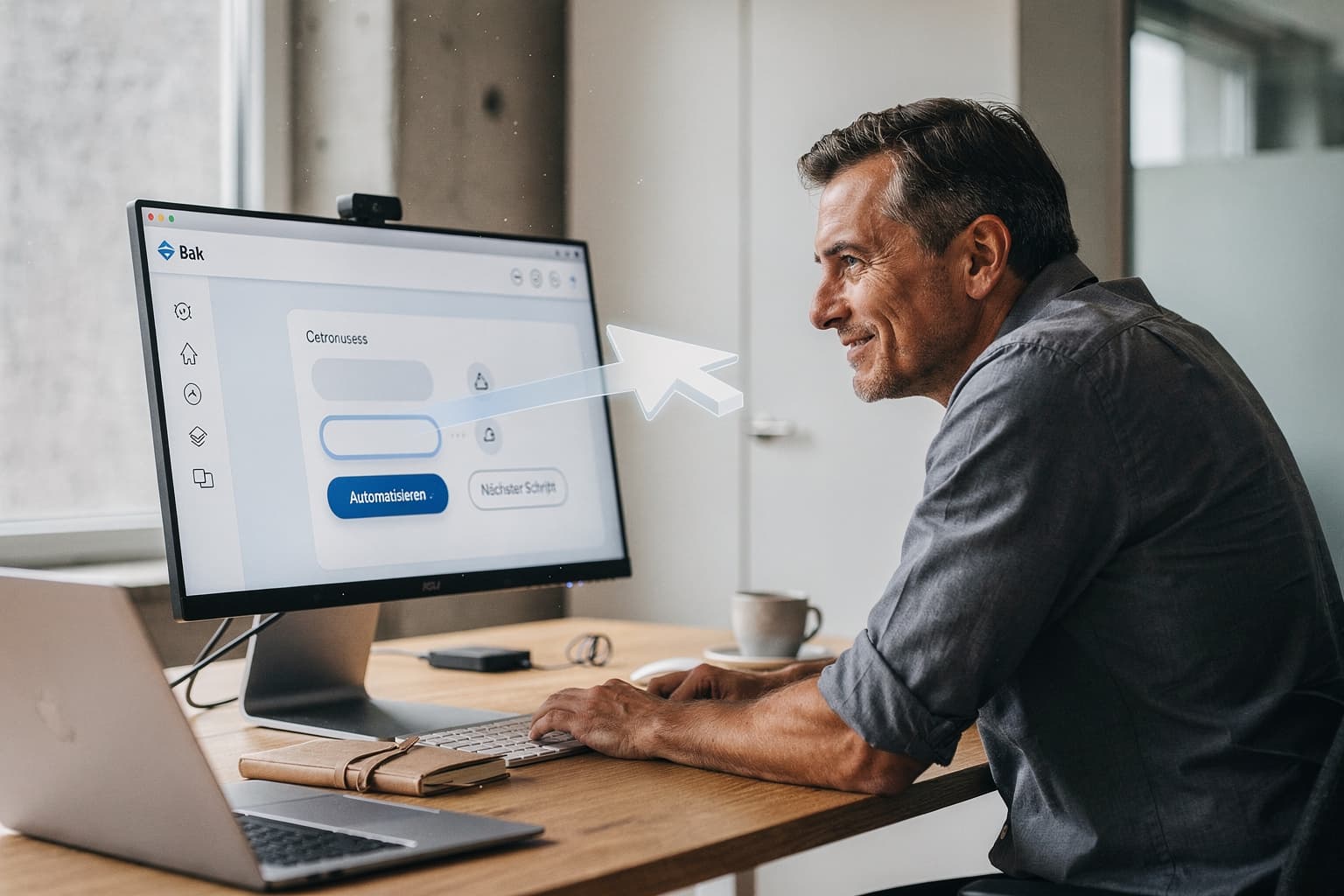
Since August 2026, the industry has been talking about a new category of agent: computer-use agents. Unlike classic AI agents that communicate with a system through an API, these agents operate software the way a person does - opening a browser, clicking buttons, filling in forms, switching between windows. Tools such as UI-TARS, Agent S3, Browser Use, Claude Cowork, Perplexity's Personal Computer agent, and Amazon Nova Act show how fast this field has moved in a matter of months.
Why This Changes Automation Reality for Swiss SMEs
Many systems Swiss SMEs rely on every day simply have no API: supplier portals, cantonal tax platforms, legacy ERP installations built up over decades, and industry-specific tools with no integration layer at all. Classic RPA tools routinely failed here, because they were built around fixed pixel coordinates or rigid UI structures and needed reprogramming after every interface change. Computer-use agents work differently: they interpret screen content contextually and adapt when a button moves or a dialog looks different.
1-2 hrs
measured daily time savings per person in early production deployments, such as invoice processing and operational workflows
Where Computer-Use Agents Are Already in Production
The earliest adopters sit in legal, accounting, and back-office functions - areas with plenty of repetitive, rule-based, but interface-heavy work. Documented production cases include utility invoice processing and operational workflows in maritime operations, where agents save one to two hours of processing time per day. At the same time, multi-agent systems as a whole are visibly moving from pilot projects into genuine production use.
- Invoice and document processing through portals with no interface
- Data entry into supplier and government portals
- Preparatory work for contract review and document reconciliation
- Master data maintenance in legacy systems without an API
- Repetitive research and reconciliation tasks in back-office functions
The Limit: Reliability and When You Still Need a Human
Realistically, many of these agents operate around a 95 percent success rate per task - good enough to deliver a genuine efficiency gain, but not good enough to run entirely without oversight. The remaining cases tend to be the same ones every time: cluttered or dynamically changing interfaces, multi-step approval processes, and, in particular, CAPTCHA or multi-factor authentication steps deliberately built to block automated access. Anyone starting today should design a review layer in from the outset - not as a stopgap, but as a permanent part of the operating model.
Security Is Not an Afterthought
An agent that operates your software using your own credentials is an access point like any other employee - with the same requirements for permission management, logging, and oversight. Treating agent access with the same rigor as a new hire's access rights is the difference between a productive pilot and an unmanaged risk.
The Cost Reality: A Genuine Alternative to Classic RPA
The economics are stark. A custom integration for a system without an API can easily cost tens of thousands of francs in development effort - and needs to be maintained again every time the interface changes. Hosted computer-use agent solutions, by contrast, typically run in the range of 20 to 200 US dollars per month, supplemented by open-source options for self-hosting. That puts a level of automation within reach that a classic integration project simply never justified on cost grounds alone.
Data Protection: Where Does Your Data Actually Run?
For many Swiss decision-makers, the data protection question is the real sticking point. The key advantage of computer-use agents is that they run in your own environment, using your own credentials. With self-hosted deployments, no data leaves your systems - a meaningful distinction for compliance under Swiss data protection law and, in regulated environments, for FINMA-relevant requirements. This does not replace sound governance, but it makes the starting position considerably simpler than with cloud-based third-party integrations.
The First Step: Start Small, Measure Cleanly
The obvious mistake is trying to automate the most complex process first. A better approach is a clearly scoped, frequently recurring workflow with no API - with a defined success criterion, so you can measure the actual success rate in your own environment before scaling. That structured entry point is what determines whether an interesting pilot becomes a reliable part of your operating model.
Frequently asked questions
- What is the difference between a computer-use agent and classic RPA?
- RPA bots follow rigid, pre-programmed click paths and break whenever the interface changes. Computer-use agents interpret screen content contextually and adapt their behaviour when a layout or button changes - which is why they also work on systems without a stable, documented interface.
- Do I need an API for a computer-use agent to work with my software?
- No. That is the core of the technology: the agent operates the graphical interface directly - clicking, typing, and navigating like a human would. This makes supplier portals, cantonal platforms, or legacy ERP systems without an interface automatable for the first time.
- How reliable are computer-use agents in practice?
- Production deployments typically show a success rate of around 95 percent per task. The remaining cases - usually complex or dynamic interfaces, CAPTCHAs, or multi-factor authentication - require human review. A control mechanism should therefore be part of any setup from the start.
- What does deploying computer-use agents cost compared to a classic integration?
- Hosted solutions typically cost between 20 and 200 US dollars per month, with open-source options available for self-hosting. A custom API integration for the same system, by contrast, often starts at tens of thousands of francs and needs to be re-maintained after every interface change.
- Are computer-use agents compatible with Swiss data protection law?
- With self-hosted deployments, the agent and its data run in your own environment, using your own credentials, with no data transmitted to third parties. This substantially simplifies compliance with Swiss data protection law, though it does not replace sound internal governance and logging.
Sources
- AI Agent News August 2026: Latest Breakthroughs
- 17 Best Computer-Use AI Agents in 2026 (Open Source & Paid)
- AI browser agents: the gap between demo and production
- Computer-Use Agents 2026: What They Can Automate
- Computer Use Agents in 2026: Claude, Operator, Stagehand Compared
- What Are Computer Use Agents? Complete Guide (2026)
Would you like to explore this topic for your company?
Check Availability