Physical AI in Construction: What Gravis Robotics Means for You
In short
Gravis Robotics, an ETH Zurich spin-off, raised $200 million in Series A funding—a headline-making robotics financing in 2025. For Swiss companies, this signals that physical AI is real, Switzerland is a hub for it, and the practical next step lies not in moonshot investments but in deploying AI agents and automation in-house.
An ETH Zurich spin-off just raised $200 million from Sequoia, Craft Ventures and a16z to make construction machinery autonomous. This is more than a Zurich success story—it is a signal that artificial intelligence has reached the physical world. For business leaders in Switzerland, the takeaway is simple: you do not need to found a robotics startup to benefit from this shift. The same core idea—AI taking over repetitive, physically or cognitively demanding work—already applies to your own daily operations.
The facts: how an ETH spin-off became a robotics heavyweight
Gravis Robotics was founded by Ryan Luke Johns, Dominic Jud and Marco Tranzatto, together with Prof. Marco Hutter of ETH Zurich’s Robotic Systems Lab. In January 2025, the company closed a $200 million Series A led by Sequoia, Craft Ventures and a16z—following a $23 million seed round with Zacua Ventures and IQ Capital. This places Gravis among the more prominent robotics financings of 2025, headquartered in Zurich with a second office in Austin, Texas.
- Ryan Luke Johns (CEO): architect and roboticist, PhD from ETH Zurich, holds the Guinness World Record for the largest dry-stone wall built by a robot
- Dominic Jud (CTO): PhD from ETH Zurich, specialist in autonomous control systems
- Marco Tranzatto (Co-Founder): former member of Team CERBERUS, winner of the DARPA Subterranean Challenge with a $2 million prize
- Prof. Marco Hutter (Co-Founder): head of ETH Zurich’s Robotic Systems Lab, serial entrepreneur
Physical AI: from niche term to multi-billion-dollar market
Physical AI describes systems that do not just process text or images but act physically—excavators that dig autonomously, robots that build walls, machines that run on construction sites around the clock. The market trajectory makes the scale clear.
$81.64B → $960B
Global physical AI market, projected 2025 to 2033 (CAGR 36.1%)
$3.1B → $10.8B
Construction robotics market, projected 2025 to 2034 (CAGR 15.8%)
$1.4B → $3.66B
Construction robots market, projected 2024 to 2030 (CAGR 18%)
Switzerland’s robotics location advantage, in numbers
That one of the year’s largest robotics rounds went to an ETH Zurich spin-off is no coincidence. Switzerland has built one of Europe’s densest robotics ecosystems, backed by figures that support this position.
- ETH Zurich ranks first in Europe on the Global AI Higher Education Index (S-GE, 2025)
- 5x more VC-backed robotics startups per capita than the UK, 6-7x more than Germany, 3.5x more than the US (Swiss Deep Tech Report 2026)
- Over 45 VC-backed robotics startups since 2020, $1.1 billion in VC funding, $3.8 billion in combined enterprise value (DeepTechNation.ch, 2025)
Quality over AI slop
Merriam-Webster named ‘slop’ its 2025 word of the year—a jab at carelessly produced AI output. Switzerland’s AI values for 2026 push against exactly that trend: subsidiarity, entrepreneurship, innovation, quality and sovereignty. This quality orientation, not just startup counts, is the real location advantage.
What this means for your company—beyond the headline
The $200 million round is a moonshot story. Most Swiss companies do not need a moonshot to benefit from physical AI—they need one well-executed first step. This is where many get stuck: staying in pilot mode instead of scaling AI agents in a structured way. A sharp take on why so many pilots stall in 2026, and what to do instead, is available in why AI pilot projects die in 2026.
We are living through a supersonic tsunami of robotics.
The retrofit approach: pragmatism over moonshots
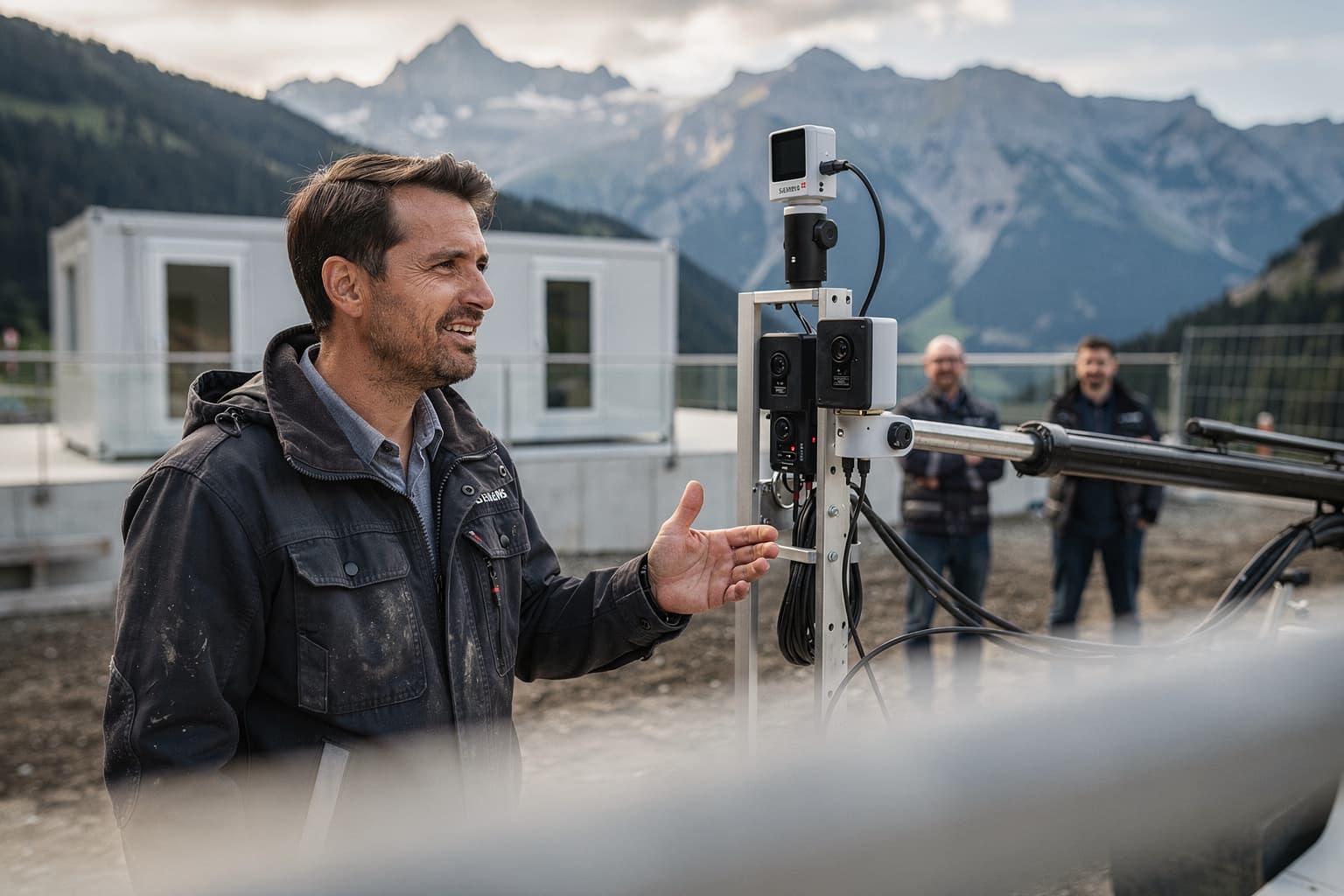
What makes Gravis Robotics particularly practical is its retrofit philosophy: instead of building new machines from scratch, the company develops a modular sensor rack—LiDAR, GNSS, IMU, and joint sensing—that mounts onto existing excavators and loaders. Working with major manufacturers such as Hitachi and Develon, this turns existing infrastructure autonomy-ready without requiring construction firms to replace their entire fleet. The same principle applies directly to knowledge work: AI agents are not introduced to replace existing systems, but as an additional layer that automates processes already in place.
Your first step: from physical AI to agentic AI in your own operation
Switzerland’s AI roadmap for 2026 projects an annual AI value gain of CHF 15 billion by 2034, supported by instruments such as Innosuisse funding, European Digital Innovation Hubs, and national sandboxes for liability-free experimentation. The regulatory framework—sector-specific rather than blanket, as envisioned by the Council of Europe’s framework convention adopted in June 2026—deliberately leaves room for entrepreneurship. The practical question is not whether to invest in AI, but where in your own operations a well-defined, rule-based task can be handed to an AI agent today.
The pragmatic first step
You do not need to wait for humanoid robots or autonomous excavators to benefit from physical-AI logic. Identify one repetitive, rule-based task in your company—quoting, invoice review, scheduling—and evaluate whether an AI agent can take it over in a structured way. That is the Gravis retrofit mindset, applied to your office instead of your job site.
Frequently asked questions
- What does physical AI mean in practice?
- Physical AI refers to AI systems that act physically in the real world—such as autonomous construction machinery, robots, or sensor-driven automation. The global market is projected to grow from $81.64 billion in 2025 to roughly $960 billion by 2033, a CAGR of 36.1%.
- Who founded Gravis Robotics?
- Gravis Robotics was founded by Ryan Luke Johns (CEO), Dominic Jud (CTO) and Marco Tranzatto, together with Prof. Marco Hutter of ETH Zurich’s Robotic Systems Lab. The company closed a $200 million Series A in January 2025, led by Sequoia, Craft Ventures and a16z.
- Why is Switzerland considered a strong robotics hub?
- ETH Zurich ranks first in Europe on the Global AI Higher Education Index. According to the Swiss Deep Tech Report 2026, Switzerland has five times more VC-backed robotics startups per capita than the UK and six to seven times more than Germany, with over 45 startups and $1.1 billion in VC funding since 2020.
- Does my company need to invest in robotics to benefit from physical AI?
- No. Most companies will not benefit through direct robotics investment but by applying the underlying principle: automating repetitive tasks with AI agents rather than waiting for moonshot projects.
- What does the Gravis retrofit approach have to do with AI agents in an office?
- Gravis retrofits existing construction machinery with a modular sensor rack instead of building new machines. The same principle—adding an AI layer to existing systems rather than replacing them—applies directly to administrative processes in any company.
Sources
- Gravis Robotics Series A Announcement
- Gravis Robotics accelerates global growth (Press Release)
- ETH ranks as Europe's top university in Global AI Higher Education Index
- Construction Robotics and Physical AI Market Research Report 2034
- Physical AI Market Size, Share & 2031 Growth Trends Report
- Swiss Deep Tech Report 2026: Robotics in Switzerland
- Robotics in Europe and Switzerland
- Switzerland’s AI Roadmap (Martel Innovate, June 2026)
Would you like to explore this topic for your company?
Check Availability