Robotics and AI Agents: Why They Strengthen Your Workforce, Not Replace It
In short
Robotics and AI agents aren't job killers — they're the most pragmatic answer to the skills shortage facing Swiss SMEs. They take on repetitive, ergonomically harmful or data-heavy tasks, freeing people for decisions, client relationships and creative work. The key is clear delegation combined with genuine workforce buy-in.
Whether robots and AI agents destroy jobs is the wrong question. The right one is: which tasks should you keep doing yourself — and which can you hand off? For Swiss SMEs, the answer is no longer a future scenario. Robotics takes over physical, repetitive work; AI agents take over recurring knowledge work. Together, they are the most pragmatic response to a skills shortage that keeps intensifying worldwide.
The three biggest misconceptions about automation
Before discussing what to delegate to machines, it's worth naming the thinking errors that sink many automation initiatives from the start.
- Treating automation as 'job theft' — provoking resistance from your own workforce instead of involving them.
- Ignoring the skills shortage and continuing to assign people to repetitive or unsafe roles that nobody applies for anyway.
- Introducing robotics or AI agents in isolation, without defining governance, process clarity or accountability beforehand.
What actually works
- Deploying robots for repetitive and ergonomically harmful tasks — the work people would rather not do anyway.
- Filling genuine staffing gaps rather than cutting roles that simply can't be filled.
- Freeing employees for higher-value, creative and relationship-driven work — and communicating that shift early and transparently.
What robotics can really do today — and what it still can't
The International Federation of Robotics' (IFR) World Robotics Trends 2026 report, published in January 2026, identifies five defining developments: the shift from analytical to generative AI ('Agentic AI'), the convergence of IT and operational technology, the growing maturity of humanoid robots, tightening requirements for safety and cybersecurity, and robots as allies against the skills shortage. The IFR's core message is unambiguous: robots take on routine tasks, open up new career paths, and make work more attractive again for younger talent.
At the same time, the IFR is cautious about humanoid robots: they still need to prove their reliability, cycle times, energy consumption and maintenance costs against traditional automation. Without that proof, the much-discussed competitive advantage remains theoretical. One company already demonstrating this maturity is Germany's Neura Robotics, with its 'cognitive robotics' technology — AI models that replicate perception, allowing systems to see, hear and understand their environment in real time.
AI-based robotics isn't science fiction. It's happening today.
AI agents: the new force in knowledge work
While robotics addresses the physical world, AI agents take on repetitive knowledge work in the office. Deloitte's 2026 Manufacturing Industry Outlook defines 'Agentic AI' as autonomous generative AI agents with genuine agency: they don't just suggest actions, they choose and execute them independently, with minimal human supervision. Deloitte ranks Agentic AI as the top technology trend of the year for manufacturing.
What is Agentic AI?
Agentic AI refers to generative AI systems that act independently, unlike traditional assistants that only respond on request. Multiple such agents can collaborate in 'multi-agent systems', handling complex, multi-step business processes without constant human steering.
This shift from simple assistants to autonomously acting systems is not without risk if scaled too fast. As Accenture's Ralf Blaschke explains, AI agents are effectively becoming 'non-biological employees', and governance frameworks need to be in place before scaling — a lesson explored further in Why AI pilot projects die in 2026 — and what companies must do instead.
Numbers that show the urgency
>400
Industrial robots per 10,000 employees in Germany — the highest density in Europe (bigdata-insider.de, 2026)
10×
How many more new industrial robots China puts into operation annually compared with Germany (bigdata-insider.de, 2026)
70%
Share of executives who rank Agentic AI as the most important technology trend of 2026 (Capgemini, cited in bigdata-insider.de)
These figures reveal a pattern: countries and companies that automate early and consistently gain a structural advantage. For Swiss SMEs, this doesn't mean competing with China or German industrial giants on volume — it means closing your own automation gap precisely where skilled labour is scarcest.
Which tasks can a Swiss SME meaningfully delegate?
Manufacturing and production
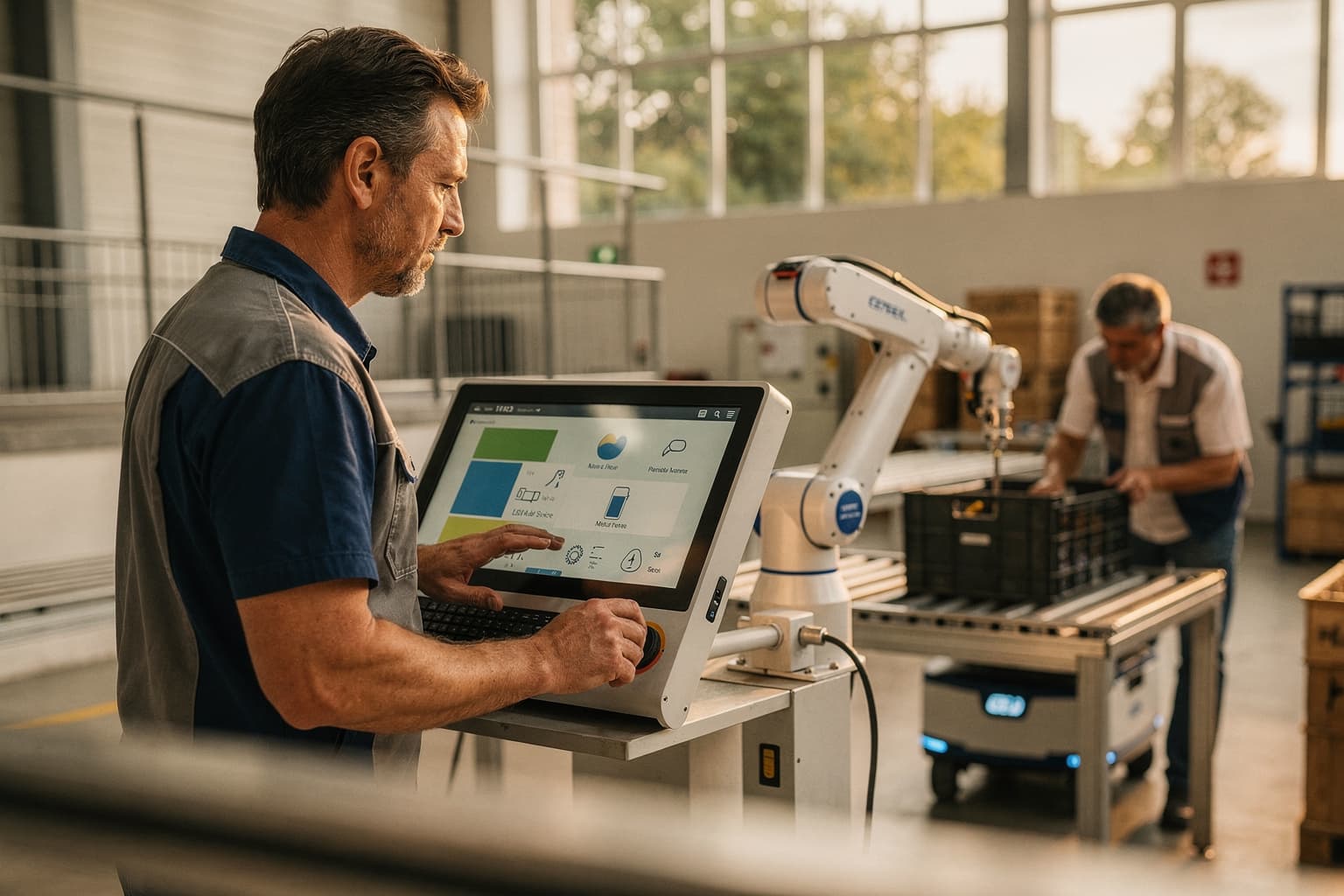
Repetitive assembly, welding or inspection steps, ergonomically demanding handling tasks, and night shifts in unpopular areas are the classic candidates. Traditional automation — or collaborative robotics where flexibility matters — takes over here, while skilled staff focus on quality assurance, changeovers and troubleshooting.
Warehousing and logistics
Order picking, in-warehouse transport and inventory monitoring can now be reliably automated. For SMEs with limited headcount, this often marks the difference between 'we can't staff that shift' and an operation that runs predictably.
Office and knowledge work
Invoice checking, scheduling, first-response customer service, and report compilation are tasks well suited to delegation to AI agents — without eliminating a single role. On why this needs to be treated as a leadership priority rather than a pure IT project, see How mid-sized companies make AI a leadership priority and gain real competitive advantage.
Bringing your workforce along: acceptance as a success factor
The IFR is explicit on this point: close collaboration with the workforce from the very start determines success or failure, in both manufacturing and services. Roll out robotics or AI agents over employees' heads, and you create exactly the resistance you were trying to avoid. Position them as tools that relieve people of unwanted burdens, and communicate that early, and you turn potential opponents into advocates.
Governance before scale
An AI agent going live without clear rules, escalation paths and accountability isn't an efficiency gain — it's a risk. Define governance frameworks before scaling from pilot to full deployment.
The skills shortage as an argument FOR automation — not against it
The skills shortage is not a reason to fear automation — it's the strongest reason for it. Where open roles genuinely cannot be filled, no robot or AI agent is replacing a human; it is filling a gap that would otherwise stay empty. Headcount reductions justified purely by AI rarely deliver the promised return, which is why redeployment, not reduction, tends to be the smarter path.
The pressure is intensifying further: major corporations such as Oracle cut jobs at scale in 2026, sharpening competition for the remaining AI and tech talent pool. For Swiss SMEs, which often lag in the DACH region when moving from pilot to production-grade AI use, gaining targeted access to external AI capacity — rather than trying to build everything in-house — is becoming a strategic necessity rather than a nice-to-have.
Conclusion: from replacement to empowerment
Robotics and AI agents are no longer abstract future concepts in 2026 — they are operational tools with demonstrable value. The essential shift in perspective for Swiss SMEs is this: it isn't about displacing people. It's about freeing them from tasks nobody wants to do voluntarily, and creating space for the work humans genuinely do better than machines.
Frequently asked questions
- Do robots and AI agents actually eliminate jobs at Swiss SMEs?
- In most cases, no. They primarily take on tasks for which no skilled staff can be found anyway, along with repetitive or ergonomically demanding work. The IFR's 2026 report explicitly frames robots as 'allies' against the skills shortage rather than replacements for existing staff.
- What is the difference between robotics and AI agents?
- Robotics addresses the physical world — assembly, transport, handling. AI agents address knowledge work: according to Deloitte, they can act independently and complete complex digital tasks with minimal human supervision, for example in office or customer service functions.
- Are humanoid robots already practical for SME use?
- The IFR remains cautious here: humanoid robots still need to prove their reliability, cycle times and maintenance costs against traditional automation. For many SME applications, conventional automation or collaborative robotics remains the more practical choice today.
- How do you get employees on board with automation?
- Early, transparent communication and close collaboration from the outset are decisive — a point the IFR emphasises explicitly. Positioning automation as relief rather than threat, and creating new roles to manage human-machine teams, significantly reduces resistance.
- Why is the skills shortage an argument for automation rather than against it?
- Because open roles often cannot be filled at all. A robot or AI agent that fills an unfilled gap isn't displacing anyone — it's what keeps the business operational in the first place.
Sources
Would you like to explore this topic for your company?
Check Availability