Tesla Optimus Gen 2.5: When Humanoid Robots Become Affordable for SMEs
In short
Humanoid robots become affordable for mid-market companies once production costs fall below the annual cost of an employee. Tesla's Optimus currently costs 50,000 to 80,000 dollars; Musk's target price is 20,000 to 30,000 dollars. Until then, much remains prototype – but the tipping point is already predictable.
Here is the answer up front: humanoid robots will not become affordable for mid-market companies when a Tesla video impresses, but when per-unit costs drop below what an employee costs per year. Right now, production costs for Tesla's Optimus sit at 50,000 to 80,000 US dollars – well above the 20,000 to 30,000 dollar target price Elon Musk has floated for mass production. Until that target is reached, the business case remains theoretical for most companies. But the direction is clear, and the point at which the calculation flips can already be estimated today.
What Optimus Gen 2.5 Actually Shows – and What It Doesn't
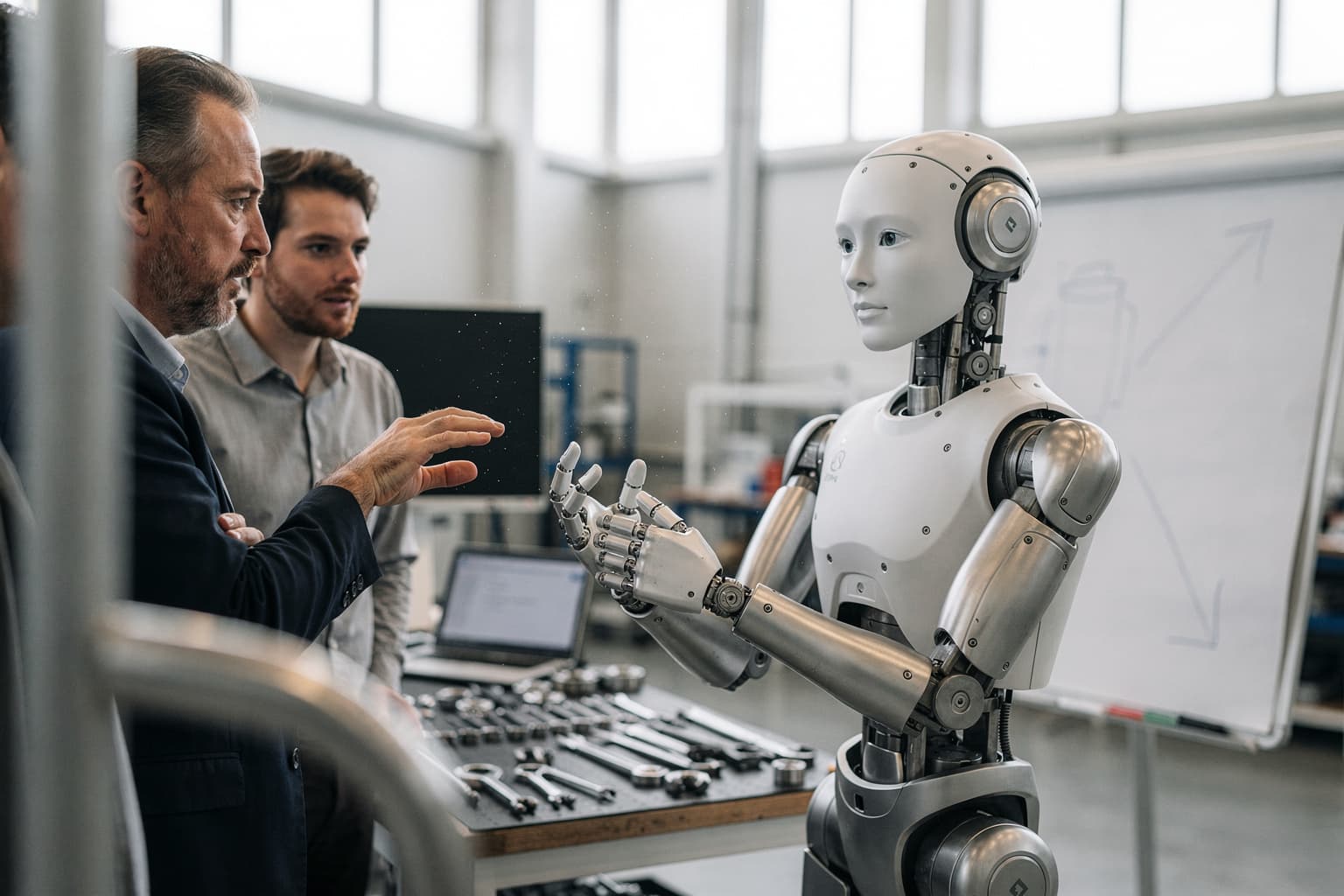
The latest Optimus Gen 2.5 demonstrations show more mature hands, more precise joints and a more stable stance than a year ago. That is real and technically notable. What the videos do not show is a commercially available, affordable machine. The current generation uses 22 degrees of freedom in the hands alone and can sort components with precision – a capability critical for industrial fine work. In early 2026, more than 1,000 units were already running in Tesla's own Texas and Fremont plants, reaching a 95 percent success rate on defined industrial tasks, with roughly 12 hours of battery life under light industrial load.
95%
Optimus success rate on defined industrial tasks in Tesla's own factories (as of June 2026)
The Calculation That Matters: Cost per Unit
For decision-makers, the materials cost breakdown tells you more than any promotional video. Morgan Stanley put the materials cost of Optimus Gen 2 at roughly 55,000 US dollars as of June 2026. The legs alone account for 21,000 dollars – 38.6 percent of total materials cost – while the hands add about 9,500 dollars, or nearly 20 percent. That tells you exactly where engineers still have work to do: legs and hands are mechanically complex, expensive to manufacture, and still far from standardized.
- Legs: 21,000 USD (38.6% of materials cost) – complex actuation for balance and gait
- Hands: 9,500 USD (approx. 20%) – 22 degrees of freedom for fine motor control and precise sorting
- Remaining components: sensors, battery, structure, control systems
- Total production cost today: 50,000 to 80,000 USD per unit
When Does the Business Case Tip for Mid-Market Companies?
The logic is simple once you apply it to real employment costs: an employee costs a company roughly the annual cost of a full-time position, depending on industry and role. If a robot's purchase price falls to 20,000 to 30,000 dollars and it stays in service for several years, the investment decision tips – provided the machine reliably performs what is still manual work today. A practical example from the hospitality industry shows how close this calculation already is: there, deploying a robot costs roughly 40,000 francs per year – 20,000 for acquisition plus 20,000 for upkeep – comparable to a full-time position. The difference lies in availability: the robot works around the clock and completes cleaning tasks roughly 80 percent faster, as a look inside luxury hospitality robotics shows.
The pragmatic first step
Before investing in hardware, it is worth asking which processes in your organization could already be relieved through physical AI and automation today – often at a fraction of the investment risk of buying a humanoid robot.
What's Already Practice Today – Not Science Fiction
Humanoid robots are no longer purely research projects. In logistics, productive deployments already show that the technology has grown beyond demo status. Clearly defined, repetitive tasks can already be automated at production scale, setting a benchmark that mid-market companies can orient themselves against before launching their own pilot projects.
The China Factor: Unitree as Price Breaker
While Tesla works on scaling and fine motor skills, China is already pushing down the price. Unitree's G1 has been available since 2026 starting at around 13,500 US dollars – well below Tesla's current production costs and even below Musk's own target price. For decision-makers, this means the race for affordable humanoid robots will not be decided in Silicon Valley alone. How Chinese manufacturers position physical AI often involves more marketing choreography than industrial substance, but the price pressure behind it is real.
Scaling: From 1,000 to 10 Million Units
Tesla is targeting production of 50,000 to 100,000 units in 2026, with the Fremont line designed for up to one million units per year. Longer term, the company has stated a goal of ten million units annually for Gigafactory Texas. Volumes at that scale are the precondition for materials costs to move toward the 20,000-to-30,000-dollar target price at all – economies of scale on legs and hands, the most expensive components, will determine the pace.
The hardest production ramp of all time.
That assessment sets realistic expectations: a commercially available, widely accessible version of Optimus is expected no earlier than late 2026 or early 2027 – and even that timeline is considered ambitious internally.
What This Means for Decision-Makers Today
The mistake would be to either wait until Optimus is on the shelf, or to invest blindly in a pilot project without first understanding your own process landscape. Many AI and robotics pilots fail not because of the technology, but because of poor preparation and unclear scaling logic, as an analysis of failing AI pilot projects shows. It makes more sense to map your own repetitive, physically demanding tasks now – sorting, transporting, cleaning, simple assembly – and assess which of these can already be addressed by existing automation solutions, or by affordable humanoid systems within the next 18 to 24 months.
An often underestimated factor is the technical sovereignty behind the hardware: anyone deploying humanoid robots in safety-relevant or data-sensitive processes needs to know where the computing power sits and who controls it. This question becomes increasingly relevant for companies as soon as robotics investments move from concept to concrete planning.
The tipping point will not arrive with a single Tesla event, but gradually: through falling materials costs, growing production volumes, and competition from China pushing prices down from below. Companies that understand their own process landscape today, and know where automation – with or without humanoid hardware – offers the greatest leverage, will not be surprised in two years. They will be prepared.
Frequently asked questions
- When will humanoid robots become affordable for mid-market companies?
- Once production costs reach Musk's targeted 20,000 to 30,000 US dollars, the calculation tips against the annual cost of a full-time employee. Today, Optimus units still cost 50,000 to 80,000 dollars, and a commercial version is not expected before late 2026 or early 2027.
- What does Tesla Optimus actually cost today?
- Total production costs stand at 50,000 to 80,000 US dollars per unit as of 2026. Morgan Stanley estimated the pure materials cost of Optimus Gen 2 at roughly 55,000 dollars in June 2026, with 21,000 dollars (38.6%) for the legs alone and about 9,500 dollars (approx. 20%) for the hands.
- Is Optimus Gen 2.5 already commercially available?
- No. The demonstrated progress in hands, joints and stance is real, but these remain prototypes and internal factory deployments. Over 1,000 units were running in Tesla's own factories in early 2026; a commercially available, widely accessible version is expected no earlier than late 2026 or early 2027.
- How does Optimus compare to Chinese competitors like Unitree?
- Unitree's G1 is already available in 2026 starting at around 13,500 US dollars – significantly cheaper than Tesla's current production costs and even below Musk's own target price. China is already creating real price pressure across the humanoid robot market.
- Does a humanoid robot already make sense for a business today?
- In select industries, yes. In hospitality, annual robot costs run around 40,000 Swiss francs, comparable to a full-time position, with 24/7 availability and roughly 80% faster cleaning performance. Across broader industry, the business case is generally not yet widespread due to still-high acquisition costs.
Sources
- Optimus-Roboter: Tesla könnte SpaceX-Bewertung überflügeln
- Tesla Optimus Gen 2: Preis, technische Daten & Kaufen
- Wirtschaftliches Potenzial humanoider Tesla-Roboter
- Optimus Gen 2: Teslas Roboter schafft 95% Erfolgsquote bei Industriearbeiten
- Tesla Optimus: Humanoide Roboter starten Serieneinsatz ab August
- Tesla Optimus Gen 2.5 LinkedIn-Quelle (Alvin Foo)

Chris Jon Graf · AI Strategist & CEO
For over 15 years, Chris Jon Graf has built productive Swiss software platforms and advised executive teams on the strategic deployment of artificial intelligence. Would you like to evaluate this topic for your company?